
BRICS Ministers call for opening of markets and economic diversification
Commerce and Industry Minister Piyush Goyal has reaffirmed India’s vision of a reformed, development-oriented, member-driven and consensus-based multilateral trading system, with the World Trade Organization at its core, preserving Special and Differential Treatment for developing countries and restoration of a fully functioning, two-tier and binding dispute settlement system.
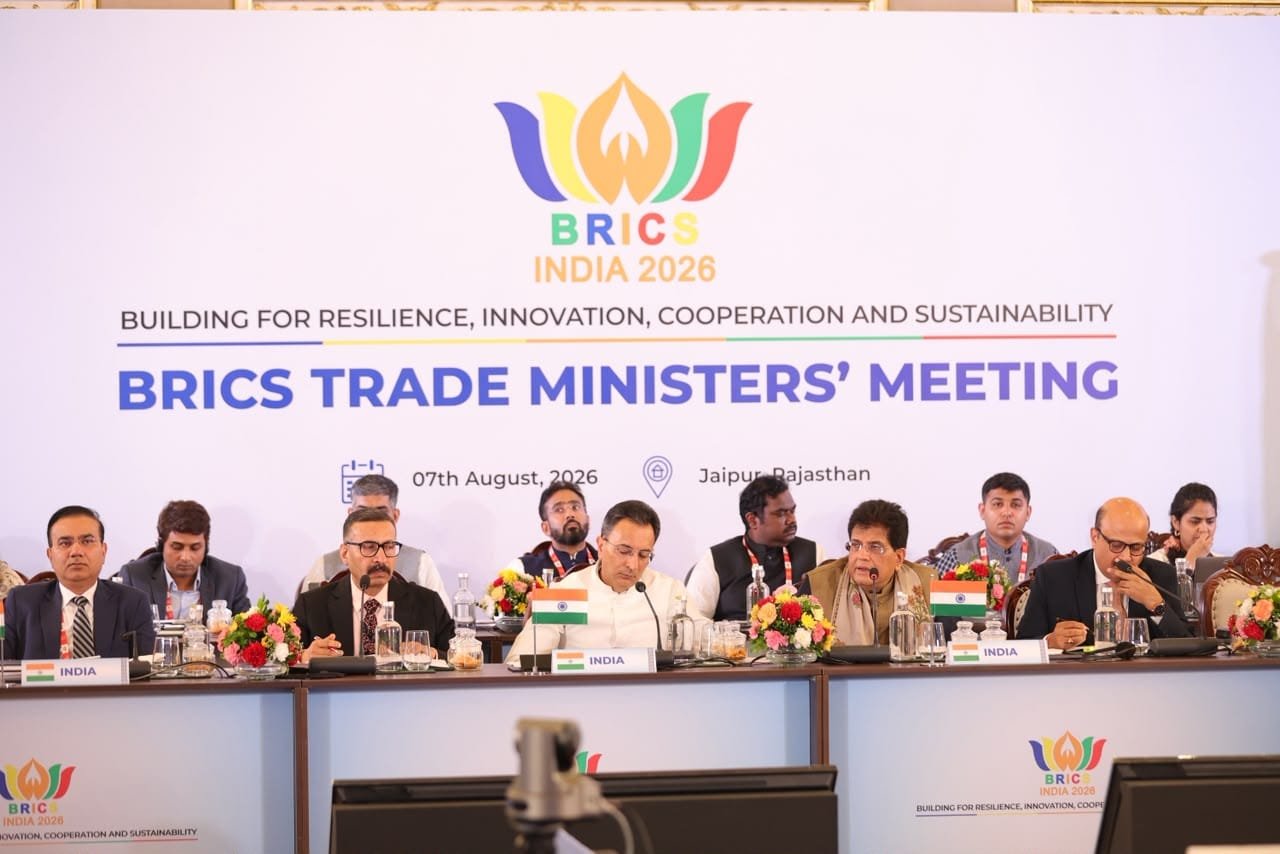
Speaking at the conclusion of 16th BRICS Trade Ministers’ Meeting in Jaipur on 7 Aug, he underlined that the most-favoured-nation principle, together with Special and Differential Treatment, remains the cornerstone of a fair, inclusive, non-discriminatory and rules-based order and that reform must strengthen this cornerstone, not dilute it.
Goyal set out India’s priorities for the Chairship of the grouping: strengthening the multilateral trading system; building resilient and diversified global value chains; internationalisation of MSMEs and their access to trade finance; and seamless flow of digitally delivered services across borders.
The Ministry of Commerce and Industry said the meeting also affirmed that the true promise of intra-BRICS trade is focused on human welfare, lies in the fortunes of micro, small and medium enterprises, in women-led businesses and in the energy of the youth of developing economies.
Trade Ministers of the member countries shared their national perspectives and emphasized the greater role of BRICS in furthering global trade. They issued the Jaipur Consensus to study a BRICS Invoice Discounting Mechanism and adopted the Guiding Principles for Credit Assessment Frameworks for Export-Oriented MSMEs, so that a firm is judged by its cash flow and not by its assets and collateral. These instruments respond directly to the global trade finance gap of about US$2.5 trillion which impacts smaller enterprises and therefore form part of the Workplan on the Internationalisation of MSMEs that was adopted.
The Ministers also advanced the opening of markets and economic diversification among BRICS Members. The Workplan on the BRICS Shared Understanding on Global Value Chains carries the GVC Action Plan 2026-2030, including BRICS Technical Council, BRICS Connect, BRICS GVC Joint Study, the possibility of establishing strategic supply chain and investment promotion platform including in pharmaceutical sector as well as food security, among others.
The BRICS Principles to Facilitate Digitally Delivered Services Across Borders, which were adopted, will help cooperation in safe and secure digitally delivered services. Together with the pursuit of balanced and expanding trade among members, these outcomes place services and value chains at the frontier of the next decade of BRICS cooperation.
Another outcome was the progress towards finalisation of the Strategy for BRICS Economic Partnership 2030, spanning the Multilateral Trading System, trade in services, the digital economy, industry, innovation and technology, trade and investment, financial cooperation and sustainable development. Ministers agreed to submit the Strategy, together with the priorities to the BRICS Leaders for endorsement.
The 16th BRICS Trade Ministers’ Meeting marks a significant milestone under India’s BRICS Chairship and reaffirms India’s commitment to an open, inclusive, transparent, equitable and rules-based multilateral trading system with the WTO at its core. The outcomes of the Meeting, anchored in the interests of farmers and small enterprises, would contribute to India’s vision of Viksit Bharat@2047 and to a future of shared prosperity among emerging economies, the Ministry of Commerce and Industry said.
Held under the overarching theme, “Building for Resilience, Innovation, Cooperation and Sustainability”, the meeting was preceded by the Third Meeting of the BRICS Contact Group on Economic and Trade Issues (CGETI), held on 3 and 4 August 2026 in New Delhi.
The Meeting brought together Trade Ministers, Vice Ministers, Heads of Delegation and officials from the BRICS member countries. The visiting dignitaries included Marcio Fernando Elias Rosa, Minister of State for Development, Industry, Commerce and Services of Brazil; Li Chenggang, China International Trade Representative and Vice Minister of Commerce of China; Dr Mohamed Farid Saleh, Minister of Investment and Foreign Trade of Egypt; Molalign Asfaw Ayana, Ambassador of Ethiopia; Dr Budi Santoso, Minister of Trade of Indonesia; Dr Mohammad Sadegh Mofatteh, First Deputy Minister of Trade and Industry of Iran; Vladimir Evgenievich Ilichev, Deputy Minister of Economic Development of Russia; Parks Franklyn Mpho Tau, Minister of Trade, Industry and Competition of South Africa; and Dr Thani bin Ahmed Al Zeyoudi, Minister of Foreign Trade of the United Arab Emirates. Fiinews.com