

VGF to support financially constrained but socially desirable projects
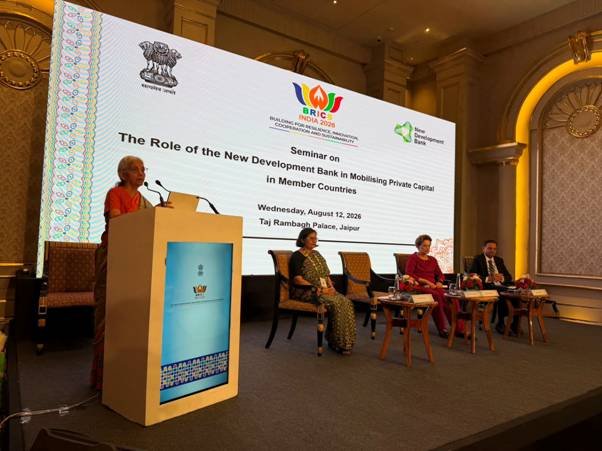
The Indian Government believes that public capital must act as a catalyst, not a substitute for private investment, Finance Minister Nirmala Sitharaman has told an international seminar on “Role of the New Development Bank in Mobilising Private Capital in Member Countries” in Jaipur on 12 Aug.
She said that the Government, in support of this principle, has carried out multiple reforms.
These are:
Viability Gap Funding (VGF) to support financially constrained but socially desirable projects;
Hybrid Annuity Model (HAM) to ensure balanced risk-sharing in road infrastructure.
Credit enhancement mechanisms to improve project bankability;
Infrastructure Investment Trusts (InvITs) to recycle capital and attract long-term institutional investors;
The National Infrastructure Pipeline, providing long-term visibility to investors.
PM Gati Shakti – National Master Plan for Multimodal Connectivity, improving coordination and efficiency
Building on this foundation, the Minister informed that the Union Budget 2026-27 introduced several targeted measures to facilitate private sector investment including:
New Dedicated Freight Corridors
New High-Speed Rail Corridors
To operationalise new National Waterways, and
A Coastal Cargo Promotion Scheme
In her Keynote Address at the seminar, she highlighted the critical role the Multilateral Development Banks play in de-risking investments, enhancing project bankability, and strengthening investor confidence so that private capital can be mobilised at scale.
She also shared India’s experience in infrastructure development. Sitharaman pointed out that the Government has strengthened its infrastructure ecosystem through sustained public capital expenditure and complementary structural reforms.
Public investment has expanded significantly compared to a decade ago, reflecting a deliberate strategy to create productive national assets across highways, railways, ports, logistics systems, digital infrastructure, and energy networks, she underlined.
The Minister spoke on the sidelines of the BRICS Finance Minsters’ and Central Bank Governors (FMCBG) Meeting in Jaipur.
Sitharaman recognised that while BRICS economies represent major growth engines of the global economy, they also face common structural constraints in mobilising private capital at scale. The challenge is not merely the availability of capital, but the creation of confidence, stability, predictability, and credible long-term frameworks which are essential to unlock sustained private participation across member countries.
The Minister concluded by emphasising that the future of development finance lies in partnership. multilateral institutions, national governments, and the private sector each bring distinct strengths. Fiinews.com