
Minister underlines importance harnessing full potential of 6G technologies
Karsten Wildberger, Federal Minister for Digital Transformation and Government Modernization, has expressed appreciation for India’s technological achievements and conveyed Germany’s interest in structured and forward-looking collaboration in advanced telecom systems, digital governance, and secure networks.
He also shared Germany’s experience in quantum encryption and secure information transport, including a demonstration of quantum communication over a 35 km link for 11 consecutive days. The German minister underlined the importance of being actively engaged with India to harness the full potential of 6G technologies.
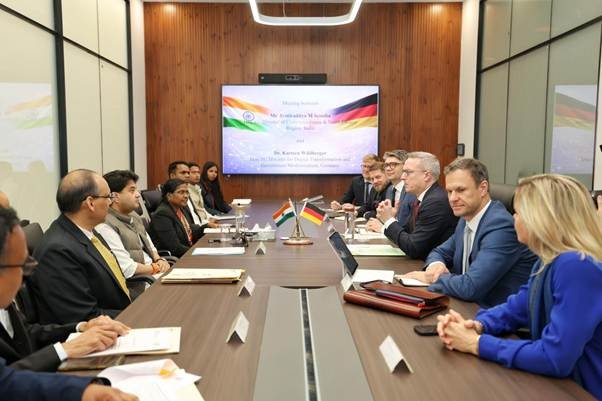
He conveyed Germany’s interest in India during a meeting with Jyotiraditya M. Scindia, Minister of Communications on 18 Feb in Delhi.
The meeting assumes significance since it followed the signing of the Joint Declaration of Intent (JDI) on 10 January 2026 during the India–Germany Summit, which establishes a forward-looking and non-binding framework for structured collaboration in telecommunications and digital governance under the broader Indo-German Strategic Partnership, the Ministry of Communications said.
Both sides welcomed the JDI as an important milestone reflecting shared values of openness, trust, innovation, and resilience in digital ecosystems. The JDI provides a flexible platform for the exchange of best practices, policy dialogue, scientific and technical cooperation, and the formulation of joint work plans to translate shared intent into actionable initiatives.
Minister Scindia stressed that the partnership should move beyond broad statements of intent toward structured and results-oriented implementation. He shared India’s digital transformation journey, highlighting that India today has over 1.23 billion telecom subscribers and nearly a billion internet users. 5G coverage extends to approximately 99.9% of the districts, supported by data tariffs averaging around US$0.10 per GB, making connectivity widely accessible and affordable. He underscored that India has laid a robust digital carriageway that offers significant avenues for international collaboration.
He highlighted the availability of affordable voice and data tariffs, which are among the lowest globally, and underscored India’s success in building Digital Public Infrastructure (DPI). In particular, he referred to the transformative impact of Unified Payments Interface (UPI), which has scaled globally as a model for interoperable digital payments; Unified Payments Interface (UPI), a fully indigenous stack processing approximately 250 billion transactions annually; and its being adopted by multiple partner countries.
The two sides discussed early convening of the first high-level meeting under the JDI framework to finalize an initial two-year work plan, identify priority focus areas, and launch flagship collaborative initiatives, with emphasis on clearly defined timelines, identification of stakeholders for each priority area, and periodic virtual review meetings to ensure outcome-driven implementation.
India and Germany reaffirmed their commitment to strengthening cooperation across emerging domains, including 5G/5G- Advanced, early engagement on 6G standardization, network modernization, trusted telecom architectures, and supply chain resilience, including collaboration on secure and sovereign 6G networks, AI at the edge, industry-grade network slicing, and scalable deployment models.
The German side expressed keen interest in fully harnessing the potential of 6G through closer engagement with India. Both sides emphasized the importance of coordinated engagement in international fora, including the International Telecommunication Union (ITU), to promote interoperable and secure global telecom standards.
Institutional collaboration between research and innovation entities was noted as a strong pillar of the partnership, with recognition of Germany’s strong industry–academia model and the need for deeper structured engagement between research institutions and industry stakeholders. The ongoing cooperation between the Centre for Development of Telematics (C-DOT) and the Fraunhofer Heinrich-Hertz Institute (HHI), including collaboration in advanced telecom R&D, quantum communications, artificial intelligence, and next-generation network technologies, was acknowledged as a model, alongside opportunities for engagement in indigenous technology development, open-source innovation networks, and Open RAN ecosystems.
Both sides recognized that 6G, Open RAN, 5G Use Case, Quantum Communication, AI in telecom, and Cyber Security are important areas of cooperation to collaborate through industry and academia by exchanging best practices, building capacity, and industry linkages.
India and Germany reaffirmed their shared commitment to building trusted networks, resilient supply chains, and future-ready digital infrastructure through sustained engagement under the Joint Declaration of Intent framework, the Ministry said.
The bilateral meeting aims to advance cooperation in telecommunications and digital transformation under the broader Indo-German Strategic Partnership. The discussions reflected mutual respect and appreciation for each other’s technological achievements, with both ministers agreeing that the present times offer significant opportunity for deeper collaboration in telecom and emerging technologies. fiinews.com