

TTDF supports indigenous telecom R&D.
The Government has released the Bharat 6G Vision Document, which outlines the roadmap for research, development, and deployment of 6G in India including identification of the spectrum for 6G, Minister of State for Communications Dr Pemmasani Chandra Sekhar has told the Rajya Sabha on 12 Mar.
The Spectrum Roadmap for 6G services has also been published, providing visibility on spectrum availability, quantum and timelines across various RF bands over the next 10 years distributed between short term (2025-2026), medium term (2027-2030) and long term (2031-2035) to enable advanced 6G applications, he said in a written reply to the house members.
Studies on 6G are being undertaken at international forums such as the International Telecommunication Union (ITU). International Telecommunication Union Radiocommunication Sector (ITU-R) has issued ITU-R M.2160-0, which outlines the framework and usage scenarios for IMT-2030 (6G). In addition, ITU-R report M.2376-0 and ITU-R report M.2541-0 provide insights on spectrum feasibility, propagation characteristics, antenna techniques, deployment architectures, and other technology enablers for future IMT systems.
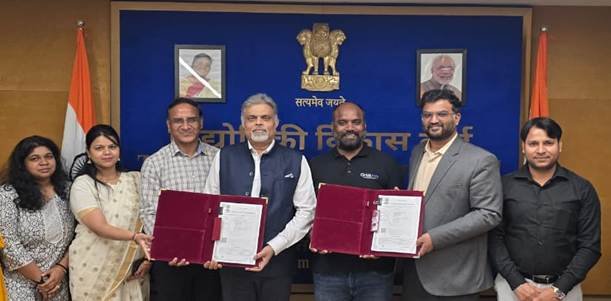
The Telecom Technology Development Fund (TTDF) scheme of DoT supports indigenous telecom R&D.
As on February 2026, 104 projects amounting Rs.271 crore has been approved for research and development of 6G technology. These initiatives provide financial and institutional support for research, testbeds, innovation and commercialization of emerging telecom technologies including 6G, he said.
He also updated Rajya Sabha on 5G services that have been rolled out in all States / UTs across the country and presently it is available in 99.9% of the districts in the country. As on 28 Feb 2026, 5.23 lakhs 5G Base Transceiver Stations (BTSs) have been installed across the country.
The several initiatives are being undertaken to promote the adoption of 5G use cases in telemedicine, precision agriculture, smart manufacturing, and education, while fostering the development of an indigenous 5G ecosystem and strengthening preparedness for next-generation technologies, including 6G.
1. Indigenous 5G Test Bed:
I. Government approved a financial grant of Rs.224 Crore in March 2018 to establish an ‘Indigenous 5G Test Bed’ in India, recognizing India’s specific requirements and aiming to take lead in 5G deployment.
II. The project involved eight collaborating institutes working together on this initiative, including Indian Institute of Technology Madras, Indian Institute of Technology Delhi, Indian Institute of Technology Hyderabad, Indian Institute of Technology Bombay, Indian Institute of Technology Kanpur, Indian Institute of Science Bengaluru, Society for Applied Microwave Electronics Engineering & Research (SAMEER), and Centre of Excellence in Wireless Technology (CEWiT), Chennai.
III. The Indigenous 5G test bed was dedicated to the nation by Hon’ble PM on 17th May 2022.
2. 5G labs:
I. Government has setup 100 5G labs across the country with an outlay of Rs. 97.67 Cr.
II. These labs are utilized for development of 5G use cases/applications in various socio-economic sectors such as education, agriculture, health, power, urban management, mining, logistics, resource management, tourism, sports, security, e- governance, etc. fiinews.com