
Connectivity must become universally affordable, says Scindia
The Communications Minister Jyotiraditya M. Scindia has held bilateral meetings with Eutelsat of France and US-based Viasat to understand the measures for advancing the universal, meaningful and resilient connectivity frameworks for India.
Both companies appreciated the vision of Minister for the provision of secure, high-speed and universal and meaningful connectivity initiatives across India http://dot.gov.in.
Scindia met the companies and industry stalwarts at Mobile World Congress 2026 (MWC 2026), held from 2-5 March2026 at Fira Barcelona Gran Via in Barcelona.
The Minister also met ITU Secretary General Doreen Bogdan-Martin who appreciated his presentation on India’s vibrant Telecom ecosystem and digital transformational journey at the Global Stage, the Ministry of Communications said on 4 Mar https://www.itu.int/en/Pages/default.aspx.
During his interactions with heavyweight telecom groups, Scindia outlined India’s vision for affordable, inclusive and future-ready digital connectivity at MWC 2026.
He also interacted with representatives of the Bharti Group, led by Sunil Bharti Mittal, reinforcing the strong synergy between Government and industry in advancing India’s digital ambitions.
He visited booths of leading global technology companies and interacted with their leadership teams.
At Meta, he was briefed on AI-enabled wearable and neural interface technologies and experienced the Meta Ray-Ban Display. He also tested the “Conversation Focus” feature of the glasses — a critical accessibility function that isolates the voice of the person one is facing in noisy or crowded environments.
At Rakuten booth, he witnessed software-defined, AI-native network architectures for scalable 5G deployment and also met the CEO, Hiroshi Mikitani.
At VVDN Technologies, he witnessed indigenously developed AI-driven Wi-Fi and network solutions.
The Minister was joined by the Chairman of the Ericsson Board, Jan Karlsson, as he observed demonstrations on advanced network technologies and emerging 6G capabilities at the Swedish group’s booth. He attended 6G demonstrations, and new radio solutions tailored specifically to India’s requirements.
During his visit to Nokia, the Minister experienced generative AI-enabled edge applications and immersive 6G use cases. He also held a detailed discussion with the President and CEO of Nokia, Justin Hotard, at the Nokia booth.
At the Intel booth, Scindia witnessed AI-optimised virtual RAN solutions powered by next-generation processors.
The visit to Cisco included demonstrations of AI-powered edge computing and network automation, while at Qualcomm, he was briefed on AI-driven RAN automation, advanced 5G modem systems and edge AI platforms.
On 2 Mar, the Minister engaged with global and Indian CEOs, and hosted dinner and exchanged views on strengthening digital partnerships, accelerating innovation and fostering trusted technology ecosystems.
The engagements at Mobile World Congress 2026 reflected India’s deepening global partnerships in telecommunications and digital innovation, and reaffirm the country’s commitment to building secure, affordable and future-ready connectivity ecosystems for inclusive growth.
He highlighted India’s vision for affordable, inclusive and future-ready digital connectivity.
Scindia delivered the Closing Keynote address at the Ministerial Stage during the session themed “Breaking the Cost Barrier.” The session focused on addressing affordability challenges that continue to exclude 3.1 billion people globally from meaningful digital participation.
Emphasising the urgency of bridging the usage gap, the Minister underscored that affordability of devices and services remains central to digital inclusion.
“Connectivity must become universally affordable if it is to be truly transformative. The challenge before us is not the absence of technology, but the cost barriers that prevent billions from participating in the digital economy,” the Minister stated.
Highlighting India’s experience in driving down data costs through policy reform, competition and scale, he added, “India’s digital journey demonstrates that scale, innovation and stable policy frameworks can dramatically reduce costs. Our collective responsibility is to ensure that next-generation connectivity — from 5G to emerging 6G ecosystems — remains affordable, inclusive and scalable.”
Scindia called for a coordinated, multi-stakeholder approach involving governments, industry, financial institutions and global bodies to enable device affordability, innovative financing models and sustainable digital ecosystems.
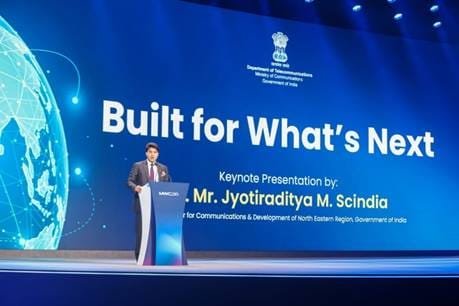
The Minister also delivered a keynote speech at a session titled “Built for What’s Next”, addressing the need to focus on the evolution, intelligent, adaptive and human-centric platforms powered by AI, cloud-native technologies and next-generation infrastructure.
The Minister underscored the evolution of connectivity from being merely a tool for access to becoming a powerful engine of opportunity, driving innovation, economic growth and social empowerment.
“We are moving into an era where networks are intelligent, autonomous and anticipatory. AI-driven systems, cloud-native architectures and secure digital ecosystems are redefining how citizens experience connectivity and how enterprises innovate,” he remarked.
He elaborated, “The future of connectivity lies not only in faster speeds, but in frictionless digital experiences, resilient infrastructure and sustainable growth. Technology must empower individuals, strengthen businesses and enable societies to thrive.”
The address reaffirmed India’s commitment to building secure, trusted and globally competitive digital infrastructure.
Another highlight at the show was the inauguration of the Bharat Pavilion featuring India’s expanding telecom manufacturing capabilities and innovation ecosystem. This year, 40 Indian companies and innovators are participating at MWC under the Pavilion.
The Pavilion brought together leading Indian companies demonstrating solutions across 4G and 5G radio networks, optical transport systems, IP/MPLS routing, broadband access, satellite communications, AI-driven network management, IoT applications, semiconductor-enabled hardware and next-generation data centre and cloud infrastructure.
The Pavilion reflects India’s emergence as a design-led manufacturing hub and a trusted global partner in cost-effective and secure connectivity solutions.
The Minister also unveiled the Curtain Raiser for India Mobile Congress 2026 which will be held from 7–10 Oct 2026 in New Delhi. It will further strengthen India’s role as a global platform for collaboration in advanced telecommunications, AI-powered networks and emerging digital technologies.
During his visit to booth of Tejas Networks, the Minister launched the TJ1600-D3 Hyper-scalable DCI Platform — a significant milestone in advanced optical networking solutions engineered in India. The launch underscored India’s growing capabilities in high-capacity data centre interconnect technologies. Fiinews.com