India advancing transition towards a gas-based economy
To further strengthen energy security, the Minister for Petroleum and Natural Gas Hardeep Singh Puri has highlighted major policy decisions, including allocations of Rs.84,084 crore under the Samudra Manthan scheme and Rs.23,731 crore for GOBARdhan.
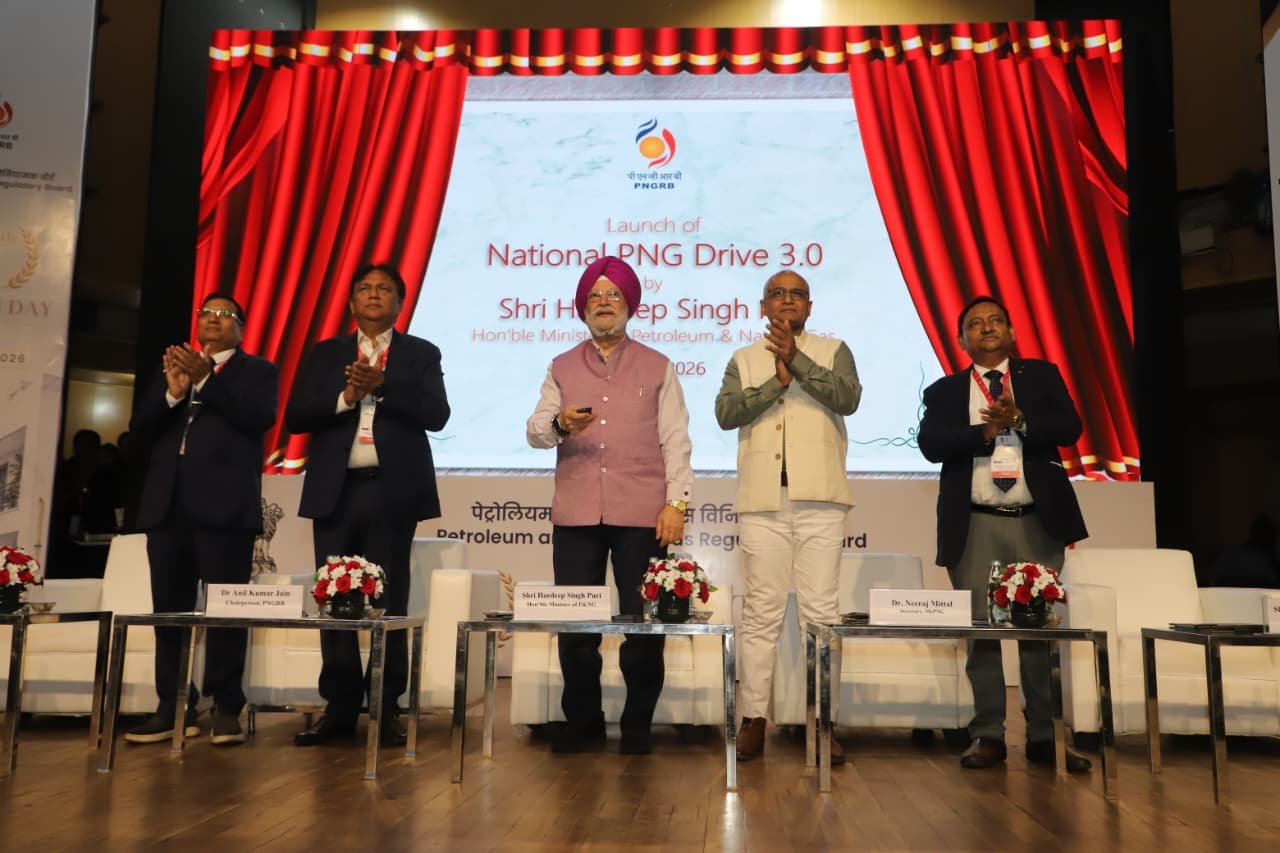
“The opening of 1 million sq km of previously restricted sedimentary basins has helped in boosting domestic hydrocarbon exploration and gas availability,” he said on 1 Oct at the Petroleum and Natural Gas Regulatory Board (PNGRB) celebrated its 20th Foundation Day
Highlighting India’s resilience in navigating global energy market volatility while advancing the nation’s transition towards a gas-based economy, he noted that despite global energy market volatility with international price spikes of 70%–80%, strategic central excise duty cuts on petrol and diesel helped keep domestic fuel prices stable and insulated Indian consumers.
The Minister also highlighted the rapid expansion of the gas distribution ecosystem. Nearly the entire country has now been authorized for City Gas Distribution, while approximately 35,000 km of natural gas pipelines have been authorized. The Unified Tariff framework has helped reduce regional disparities and improve access to gas in distant and underserved regions.
Reaffirming the nation’s commitment to increasing the share of natural gas in the primary energy basket from current level of around 6%, the Minister also pointed to the momentum generated by National PNG Drive 2.0. During the six-month drive from January to June 2026, around 12.10 lakh new PNG connections.
During the West Asia crisis, the Government ensured continuity of essential gas supplies, while the CGD sector continued to expand PNG adoption and strengthen coordination with States and other stakeholders, he underlined.
The Minister also highlighted PNGRB’s technology-enabled approach to regulation through the National Hydrocarbon Infrastructure Monitoring System (NHIMS), which brings together infrastructure, administrative, transport, geographical and satellite data on a common digital platform. The system is expected to strengthen monitoring, planning and regulatory oversight and enable more informed and timely decision-making.
Looking ahead, Minister Puri underscored the need for faster and more effective digital grievance redressal, timely expansion of CGD networks into new areas, healthy competition, stronger sectoral capacity and a regulatory framework that keeps pace with India’s sustainability and Net Zero objectives. PNGRB’s continued independence and arm’s-length position from administrative and commercial interests, together with a clear, transparent and predictable regulatory framework, will remain important in building confidence across the industry.
Addressing the gathering, the Ministry of Petroleum and Natural Gas Secretary Dr Neeraj Mittal emphasized the evolving role of regulation in driving actual gas adoption across sectors, stressing that success must now be measured not merely by pipeline length laid, but by actual gas consumption, molecule utilization, and the speed at which household PNG connections multiply.
He encouraged CGD entities to leverage special schemes to reduce cost recovery timelines from 10–15 years to 2–3 years, thereby addressing major financial roadblocks to network expansion. He also underlined the importance of coordination between upstream, downstream, Oil PSUs and the Government to ensure an uninterrupted clean energy supply. Fiinews.com