
Rajnath Singh notes growing synergy between civil aviation and defence aerospace capabilities
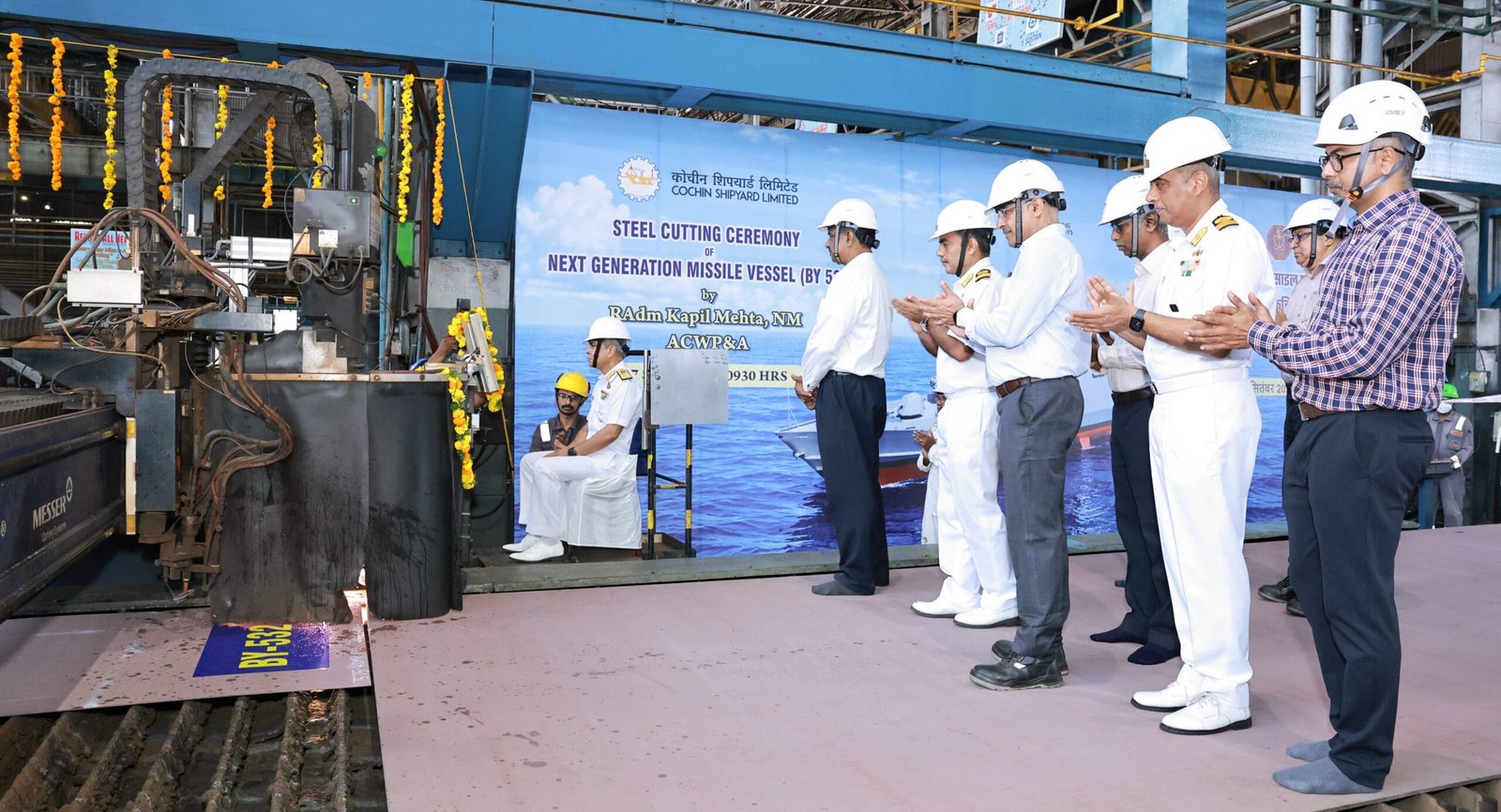
The Next Generation Missile Vessel (NGMV), a steel cutting ceremony of which was held at Cochin Shipyard Limited (CSL) on 17 Sep 2026, will be equipped with the state-of-the-art weapon and sensors, which would significantly enhance the combat capabilities of the Indian Navy as a ‘Future Ready and Combat Ready Force’.
The construction of the ships reinforces India’s commitment to build a strong and modern Navy, capable of operating in the complex maritime environment of the Indian Ocean Region, the Ministry of Defence said on 18 Sept.
Contract for construction of NGMVs was concluded with CSL in March 2023.
Further, all the major role defining equipment have been indigenously developed and manufactured, underscoring the Nation’s prowess and are in consonance with GoI initiative of ‘AatmanirbharBharat’ ‘Makeinindia’ and ‘MakefortheWorld’.
Separately, the Hindustan Aeronautics Limited (HAL) has handed over two Light Combat Aircraft (LCA) Tejas Final Operational Clearance (FOC) Twin Seater Trainers & three HTT 40 Basic Trainers to the Indian Air Force (IAF), and four Dhruv Next Generation (NG) helicopters to Pawan Hans Limited (PHL) in Bengaluru on 18 Sept.
Officiating at the ceremony, Defence Minister Rajnath Singh described the handing over as a significant milestone in the nation’s progress towards indigenous aerospace capability, technological self-confidence and self-reliance. “Our aim is to make India capable, self-reliant, and globally competitive in meeting its aerospace requirements,” he said.
“We’ve taken steps to not only provide the opportunity to Defence Public Sector Undertakings (DPSUs) to advance in the defence sector, but also encourage the private industry, ensuring a level playing field,” he added.
Rajnath Singh stressed the need to advance systematically in the aerospace sector, terming self-reliance in the domain as the need of the hour. “There can be no sudden ‘big bang’ in the development of aerospace systems. It is a vast and gradual process involving a wide range of components. All the products and components involved represent small rungs on a long ladder; we must move forward one step at a time. Naturally, there would be challenges, but we need to view them as milestones on a larger roadmap to achieve progress in a sector as complex and crucial as aerospace,” said the Minister.
Rajnath Singh also termed the handing over ceremony as a symbol of the growing synergy between civil aviation and defence aerospace capabilities, emphasising that the development of a robust aerospace industry should not be limited merely to meeting defence requirements. He called for building an ecosystem capable of effectively addressing the needs of both the civil and military aviation sectors.
“When capabilities such as aircraft design, avionics, propulsion, composite materials, flight control systems, manufacturing, and certification are developed within the country, they benefit the entire aerospace sector. We must build an integrated aerospace ecosystem which is self-reliant across every domain. I am confident of achieving this endeavour through our collective strength,” he said.
Asserting that the nature of warfare is rapidly evolving, and future air operations will be information-intensive and technology-driven, Defence Minister underscored the importance of developing complex systems indigenously. He stated that combat effectiveness can only be ensured through a combination of well-trained personnel, advanced technology, integrated systems, and rapid decision-making, expressing confidence that LCA FOC Trainer will play a crucial role in preparing the pilots for this demanding operational environment. “While the Dhruv-NG exemplifies our indigenous civil aerospace prowess, LCA FOC Trainer stands as a symbol of indigenous military aerospace capability and the maturity of its fighter aircraft ecosystem,” he added.
On the HTT-40, Shri Rajnath Singh stated that India had, for years, relied on imported aircraft to meet its basic training requirements, but HAL is now indigenously manufacturing HTT-40 to cater to the needs of IAF. Highlighting the aircraft’s export potential, he expressed confidence that the HTT-40 would find demand in international markets and fulfil its intended role in strengthening India’s aerospace capabilities.
Defence Minister also highlighted HAL’s expertise across aircraft manufacturing, helicopter development, overhaul, repair, maintenance and aerospace engineering, calling it a pillar in India’s endeavour to build indigenous aerospace capabilities. He exhorted the DPSU to further expand its capabilities across the entire aerospace value chain, including design, development, manufacturing, certification, lifecycle support and global marketing.
Terming R&D as a crucial priority area, he urged young scientists, engineers, designers, test pilots, and technicians to take it as a challenge to create technologies that do not exist today. He called upon them to develop capabilities that secure a leading position for India in the global aerospace technology landscape over the coming decade.
Rajnath Singh stressed the need to not view public and private sectors as competitors, but collaborators. “There is a need for enhanced public-private synergy to build next-gen indigenous aerospace capabilities. By working together, we can accelerate the growth of India’s aerospace sector. We must prepare for the sector’s transformation through Artificial Intelligence, autonomous systems, unmanned aerial systems, electronic warfare, cyber technologies, and next-generation propulsion, with a strong focus on their indigenous development and integration. Let us all resolve to make India not only self-reliant in the field of aerospace technology but also a global leader,” he said.
The LCA Twin Seater Trainers are the final two aircraft under the FOC contract. The aircraft will support the Indian Air Force’s training requirements and provide pilots with an indigenous training continuum into frontline fighter operations. The Tejas Trainer retains the core systems and combat capability of the frontline platform, enabling pilots to train on the aircraft they will eventually fly in service.
The HTT-40 (Hindustan Turbo Trainer-40) is an indigenously designed and developed Basic Trainer Aircraft intended to meet the primary training requirements of the Defence Forces. The aircraft is built around a proven turboprop engine and is designed to provide good low-speed handling characteristics and effective training for trainee pilots. It incorporates a modern cockpit and avionics suite and is capable of performing a range of basic training and flying roles, including aerobatics, general handling, instrument flying, navigation, night flying and close formation flying.
The Dhruv NG marks an important step in HAL’s entry into the civil and commercial rotary-wing segment. Configured for civil operations, the helicopter incorporates enhanced systems, modern avionics and a more powerful engine. It is intended for a range of applications including passenger transport, emergency medical services and offshore logistics. Fiinews.com