
Critical minerals essential for next phase of technological competition
Global trust in India is rising, and by securing mineral supply agreements, the government and stakeholders are insulating the country’s technology sector from future global shocks, G. Kishan Reddy, Minister of Coal and Mines, said on 11 Sept.
“Sustainable mining and developing the critical mineral value chain will be the key to achieving the two goals of becoming a self-reliant developed nation in the next 20 years and becoming a net-zero economy by 2070. We must work together to make India’s mineral sector more modern, more responsible, more competitive, more employment-generating and more globally connected,” he said.
“The next phase of technological competition is essentially going to have critical minerals as a very important component. When we talk of critical minerals, it is no longer confined only to mining policy. It is also to do with energy security, industrial competitiveness and national security,” added Dr Jitendra Singh, Minister of Science and Technology.
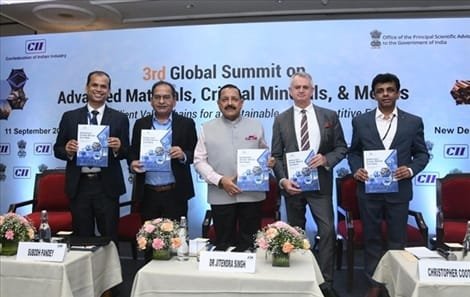
“We have to follow a global strategy; we have to live up to global benchmarks,” said Dr Singh as he joined Reddy at the CII 3rd Global Summit on Advanced Materials, Critical Minerals & Metals under the theme ‘Building Resilient Value Chains for a Sustainable and Competitive Future’.
Reddy pointed out that the Geological Survey of India has taken up 300 critical mineral exploration projects this year alone, and four critical mineral processing parks are being developed with the state governments of Gujarat, Maharashtra, Andhra Pradesh and Odisha.
India has acquired five lithium blocks in Argentina and entered into partnerships with Japan, Peru, the UK and the USA. Terming urban mining a major opportunity, he noted that 58 entities have been cleared under the critical mineral recycling incentive scheme, and encouraged technology startups to look at mining as an area of innovation, he pointed out.
Dr Singh highlighted initiatives such as the National Critical Mineral Mission, the opening of the nuclear sector to private participation and the Rs.1 lakh crore RDI Fund, and urged early industry engagement, advising that potential industry partners be kept on board right from day one of any project. He outlined five priorities: investment, building domestic capabilities, deeper partnerships, recycling models and a culture of philanthropy for research, and called for partnerships with the highest integrity.
While addressing at the CII summit, Christopher Cooter, Ambassador, High Commission of Canada to India, underlined Canada–India relationship, assuring that the bilateral ties have entered a new phase, and there has never been a better moment to work with Canada on critical minerals. Both India and Canada possess advanced technology, resources, capital, and talent needed to build critical minerals.
“Advanced materials and critical minerals are both at the fulcrum of national security, economic security and energy security. Our ambition must not be merely to secure the raw material, but to master the material. We should not only be manufacturing the component, but we should also be owning the technology. And we should not only be participating in the global supply chain; we have to become an indispensable part of it,” said Lekhan Thakkar, Joint Secretary National Security Council Secretariat (NSCS).
“Control of refining will be controlling the technology. The most important part is how to take this whole effort that has come out from national laboratories into a scale-up mode. Government has to create an ecosystem which will promote this translation from lab to scale,” said Dr V K Saraswat, Chancellor; Graphic Era University – Chairman, Quantum Ecosystems and Technology Council of India, Distinguished Professor at IIT Hyderabad and IIT Roorkee & Former Hon’ble Member, NITI Aayog, Government of India.
“Materials are often the hidden enablers of technological progress. This makes critical minerals and advanced materials not merely an industry issue, but a strategic national priority. We need stronger collaboration between industry, academia, startups and national laboratories to take promising technology from the laboratory to pilot scale and ultimately to commercial technology,” said Subodh Pandey, Chair, CII National Task Force on Advanced Materials, Critical Minerals, and Metals; and Vice President & Head–Technology, R&D, NMB and Graphene, Tata Steel
“Historically, in many different segments, we have seen that import dependency ultimately became the fuel for innovation within the country. When we got denied access to supercomputers, we created PARAM. When we got denied access to nuclear technology, we built our own reactor ecosystem. Critical minerals and advanced materials stand at that inflection point. I do believe this could be India’s moment to shine, given the huge abundance of talent and experience that we have had,” said Rajat Verma, Co-Chair, CII National Task Force on Advanced Materials, Critical Minerals, Metals and Founder and CEO, Lohum. Fiinews.com