

India-NZ to work on NZ$7 bn bilateral trade by 2030
Prime Ministers Narendra Modi and Christopher Luxon have directed Ministers and senior officials to maintain close engagement and ensure timely implementation of the initiatives set out in the “Roadmap to 2030” for further developing bilateral relations between India and New Zealand. They leaders agreed that progress would be reviewed regularly by Ministers and senior officials.
PM Modi paid an official visit to New Zealand 10-11 July, the first by an Indian Prime Minister in 40 years, marking a historic milestone and charting a new course in the enduring friendship and partnership between the two nations.
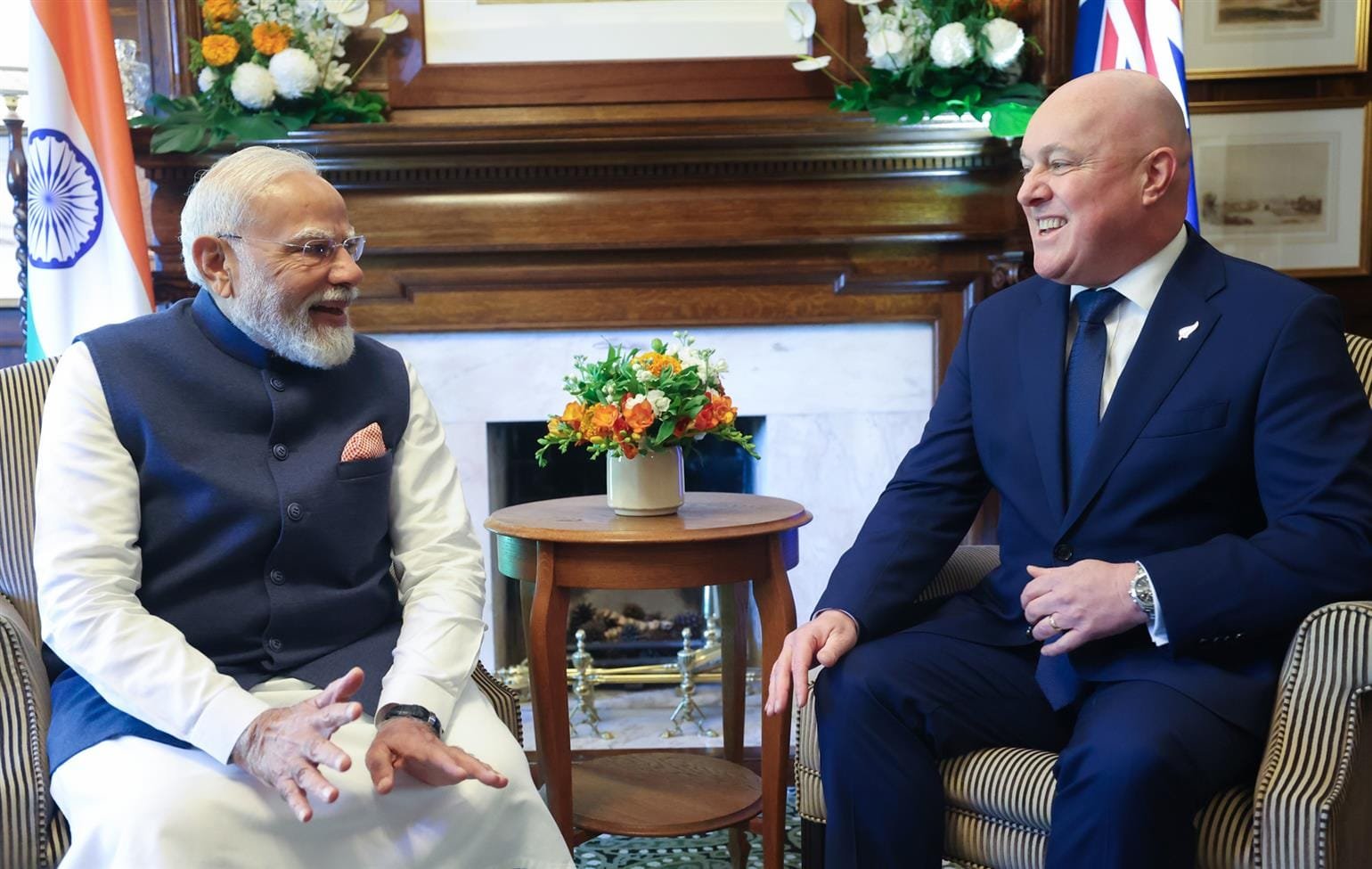
During the visit, Prime Minister Modi held bilateral discussions with Prime Minister Luxon, and addressed business leaders and members of the Indian community in New Zealand.
Recognising the long-standing friendship between India and New Zealand, shared democratic values, deep people-to-people links, and shared interests in the Indo Pacific, the two Prime Ministers decided to elevate the bilateral relationship to a ‘Strategic Partnership’. They accordingly endorsed the ‘India-New Zealand Strategic Partnership: Roadmap to 2030’ as a framework to guide joint action over the next four years.
The Prime Ministers agreed to an ambitious long-term vision for the Strategic Partnership, which aims to take bilateral relations to a new level, strengthen existing cooperation mechanisms and explore new avenues for deepening cooperation, both bilaterally and multilaterally.
The Prime Ministers welcomed the increasing momentum of high-level political engagement and agreed to hold regular reciprocal visits and meetings between the respective Prime Ministers and Ministers, including on the sidelines of regional and multilateral events.
To provide strategic guidance to the relationship and review progress under the Roadmap to 2030, the Prime Ministers agreed to establish a regular Foreign Ministers’ Dialogue and consolidate the practice of annual senior officials’ meetings between India’s Ministry of External Affairs and New Zealand’s Ministry of Foreign Affairs and Trade.
They acknowledged the important contribution of parliamentary exchanges to deepening mutual understanding and strengthening the democratic foundations of the India-New Zealand relationship. They encouraged regular engagement between the Parliaments of both countries, including through the recently constituted Parliamentary Friendship Group for New Zealand in the Indian Parliament, and visits by Members of Parliament.
Defence and Security Cooperation
The Prime Ministers welcomed progress in defence and security cooperation, including the implementation of the 2025 India-New Zealand Memorandum of Understanding on Defence Cooperation. The Prime Ministers agreed to maintain regular structured engagement at Defence Ministry and Service levels. They highlighted cooperation under Combined Task Force 150 (CTF-150) in 2025, with New Zealand in command and India as Deputy Commander, supporting efforts to deter narcotics smuggling, terrorism, and illicit maritime activity in the Middle East and the Western Indian Ocean.
The Prime Ministers noted that India and New Zealand, as maritime nations, share an interest in a free, open, peaceful, and prosperous Indo Pacific. They accordingly agreed to strengthen maritime cooperation, including through the newly concluded Maritime Cooperation Arrangement (MCA), an Implementing Arrangement on Cooperation in Matters of Hydrography and Nautical Cartography, and a Mutual Logistics Support Arrangement focused on the maritime domain. They also welcomed naval activities, including bilateral naval exercises, as part of the MCA.
India welcomed New Zealand’s nomination of Maritime Security as its priority pillar under the Indo-Pacific Oceans Initiative, and both sides agreed to explore specific cooperation activities under this pillar. They also agreed to establish an annual Maritime Security Dialogue to strengthen cooperation, coordination and information exchange.
The Prime Ministers reaffirmed their shared commitment to strengthening cooperation on counter terrorism, cyber security, and related security challenges. They agreed to explore opportunities for closer engagement, including through dialogue and collaboration in relevant regional and multilateral settings, with a view to supporting international peace, security, and resilience.
The Prime Ministers agreed to strengthen practical law enforcement cooperation to combat transnational and organised crime, including illicit drug trafficking, financial crime, cyber-enabled crime, terrorism-related offences, people smuggling and trafficking in persons. They agreed to work towards the early formalisation of arrangements on counter-narcotics cooperation and law enforcement cooperation between the relevant Indian and New Zealand agencies.
Trade and Economic Cooperation
The Prime Ministers welcomed the momentum in the trade and economic relationship while recognising that there remains significant room for growth. They agreed to work towards the aspirational goal of doubling bilateral two-way trade in goods and services to NZ$7 billion or approximately Rs.35,000 crore, by 2030. They encouraged businesses to deepen links, explore opportunities, and build on complementarities between the two economies.
The Prime Ministers welcomed the conclusion and signature of a balanced, comprehensive and mutually beneficial India-New Zealand Free Trade Agreement (FTA). They agreed to work together to ensure its early entry into force and effective implementation.
The Prime Ministers recognised the important role of the FTA in strengthening the bilateral economic partnership, including through the removal of barriers to trade, increased cooperation, and New Zealand’s promotion of investment into India. The Prime Ministers noted that New Zealand can support India’s Viksit Bharat goal to become a developed country by 2047, including through cooperation in trade, agriculture, skills, innovation, clean energy, sport, and other areas.
Recognising the positive role of tourism in generating economic growth and cultural understanding, they welcomed the signature of a Memorandum of Arrangement on Tourism. They again encouraged airlines to commence direct non-stop flights between India and New Zealand.
The Prime Ministers welcomed the growing partnership between India and New Zealand in the primary industries, including horticulture, forestry, animal husbandry and dairying. They noted that this cooperation draws on New Zealand’s globally recognised expertise in productivity, food safety, sustainability, post-harvest systems and value chain development, and supports India’s priorities for sustainable agricultural growth.
The Prime Ministers welcomed the Agricultural Productivity Partnership under the Free Trade Agreement as a key platform for practical cooperation, including New Zealand’s work with India on action plans to help lift productivity in kiwifruit, apples and honey. They noted New Zealand’s support for the establishment of Centres of Excellence in kiwifruit in India and welcomed education and institutional collaborations that will support agricultural innovation, skills development and stronger industry linkages. The Prime Ministers also welcomed the conclusion of the Memorandum of Cooperation on Animal Husbandry and Dairying.
The Prime Ministers welcomed the continued dialogue between India’s Directorate General of Shipping, Ministry of Ports, Shipping and Waterways and Maritime New Zealand on opportunities to strengthen the recognition of seafarer competency certificates. They noted that enhanced recognition of seafarer competency certificates would support seafarer mobility, strengthen cooperation between maritime authorities, and contribute to the resilience and capability of both countries’ maritime industries.
The Prime Ministers welcomed celebrations to mark 100 Years of Unity Through Sport in 2026. They further welcomed the India-New Zealand Joint Action Plan on Sport, which provides a practical framework to strengthen bilateral sporting ties, including through high performance sport, coaching, sport science, participation, sport business, and exchanges between national sporting organisations.
The Prime Ministers welcomed the continued deepening of cultural cooperation between India and New Zealand, including through engagement on traditional medicine, the commencement of an Arrangement on Cultural Cooperation, and the Memorandum of Arrangement between the National Maritime Heritage Complex, Lothal, India, and the New Zealand Maritime Museum. They noted that these initiatives provide valuable opportunities to strengthen people-to-people links, promote mutual understanding, and celebrate the rich cultural heritage, contemporary creativity, and longstanding maritime connections between both countries.
Education, Research, Science and Technology, and Disaster Management
The Prime Ministers acknowledged that education, research, science and technology, and innovation are key aspects of the bilateral relationship. They encouraged government officials, institutions and industry to scope and build partnerships in agriculture, climate, digital transformation, science, innovation and new and emerging technologies.
The Prime Ministers recognised education as a central pillar of the relationship, underpinning people-to-people links, skills development, research collaboration and long-term economic partnership. They welcomed the growing connections between education institutions in both countries and agreed to strengthen cooperation in ways that support student mobility, institutional partnerships, innovation and mutual understanding. They reflected on progress in implementing the 2025 Education Cooperation Arrangement and acknowledged the engagements and new institutional partnerships developed since the signing.
The Prime Ministers recognised the shared challenges of climate change and the transition to low-emissions and climate-resilient economies. They agreed to deepen cooperation through the International Solar Alliance and the Coalition for Disaster Resilient Infrastructure. Prime Minister Modi welcomed New Zealand joining the Global Biofuels Alliance.
The Prime Ministers welcomed the signing of a Memorandum of Cooperation (MoC) between the National Disaster Management Authority of India and the National Emergency Management Agency of New Zealand. They reaffirmed the importance of strengthening bilateral cooperation in disaster risk reduction, preparedness, response, recovery, and resilience building, with a view to enhancing the resilience of communities, infrastructure, and institutions in both countries.
The Prime Ministers looked forward to advancing research, innovation and practical solutions to support more sustainable, productive and climate-resilient agriculture and food systems.
Regional and Multilateral Cooperation
The Prime Ministers exchanged views on their respective approaches to the Indo Pacific and reaffirmed their commitment to a free, open, peaceful, and prosperous Indo-Pacific region, where sovereignty and territorial integrity are respected, and the rules-based international order is upheld.
They reaffirmed freedom of navigation and overflight, and other lawful uses of the seas, in accordance with international law, particularly the 1982 United Nations Convention on the Law of the Sea. Both sides reaffirmed the need to pursue peaceful resolution of disputes in accordance with international law, particularly UNCLOS. They emphasised the importance of working together towards security and prosperity in the Indo-Pacific.
The leaders noted the importance of cooperation in ASEAN-led and other regional fora, including the East Asia Summit, the ASEAN Regional Forum and the ASEAN Defence Ministers’ Meeting Plus. They reaffirmed the importance of ASEAN centrality and the ASEAN Outlook on the Indo-Pacific.
The Prime Ministers emphasised the importance of an effective multilateral system centred on the United Nations. They stressed the need for bold and effective UN reform and affirmed their support for expansion of the Security Council in both permanent and non-permanent categories to better reflect contemporary geopolitical realities. In this regard, New Zealand reaffirmed its support for India’s permanent membership of a reformed and expanded United Nations Security Council.
The two sides reaffirmed their strong commitment to global peace and security, universal, non-discriminatory and verifiable nuclear disarmament, and upholding the global non-proliferation architecture. The Prime Ministers again acknowledged the value of India joining the Nuclear Suppliers Group, in the context of predictability for India’s clean energy goals and its non-proliferation credentials.
The Prime Ministers expressed concern over renewed escalation of tensions in the Middle East and called upon all parties to exercise restraint, de-escalate tensions, and ensure protection of civilians. They called for full restoration of freedom of navigation and the global flow of commerce through the Strait of Hormuz, while opposing any constraints on shipping. They reiterated the importance of dialogue and diplomacy, and adherence to international law to achieve a peaceful and lasting solution to the conflict.
List of outcomes from PM Modi visit to New Zealand:
Memorandum of Arrangement on Maritime Cooperation between the Ministry of Defence of India and the New Zealand Defence Force – Establishes a framework for enhanced maritime cooperation in the Indo-Pacific through dialogue, coordination, information exchange, and joint activities.
Implementation Arrangement concerning cooperation in matters of Hydrography and Nautical Cartography between India and New Zealand – Strengthens hydrographic cooperation through joint production of navigational charts, hydrographic data sharing, training, and capacity building.
Arrangement concerning the provision of Mutual Logistics Support between the Indian Navy and the New Zealand Defence Force – Facilitates reciprocal logistics support between the Indian Navy and the New Zealand Defence Force during approved activities and operations.
Arrangement on establishing a Joint Working Group on Counter-Terrorism between India and New Zealand – Establishes a Joint Working Group on Counter-Terrorism to strengthen cooperation, exchange information, and coordinate efforts to combat terrorism.
Memorandum of Cooperation between the National Disaster Management Authority of India and the National Emergency Management Agency (NEMA) of New Zealand – Promotes collaboration in disaster risk management, with emphasis on earthquake resilience, tsunami preparedness, coastal hazard mitigation, knowledge exchange, policy dialogue, and capacity building.
Memorandum of Cooperation in the fields of Animal Husbandry and Dairying between the Ministry of Fisheries, Animal Husbandry and Dairying of India and the Ministry of Primary Industries of New Zealand – Creates a framework for enhanced cooperation in animal husbandry and dairying through technical collaboration, knowledge exchange, and best practices.
Memorandum of Arrangement in the field of Tourism between the Ministry of Tourism of India and the Ministry of Business, Innovation and Employment of New Zealand – Promotes cooperation in tourism to strengthen economic ties, increase tourist flow, and enhance mutual understanding of each country’s culture.
India-New Zealand Joint Action Plan on Sport – Provides a framework for collaboration in sports, including high-performance sport, sports science, sports medicine and athlete development.
Memorandum of Arrangement for development of National Maritime Heritage Complex (NMHC), Lothal at Gujarat between NMHC and New Zealand Maritime Museum – Provides a framework for cooperation in developing NMHC at Lothal through collaboration and mutually agreed projects.
Arrangement on Cultural Cooperation between Ministry of Culture of India and Ministry of Culture and Heritage of New Zealand – Promotes cultural cooperation through exchanges in arts, heritage, and cultural initiatives to strengthen mutual understanding and people-to-people ties.
Announcements:
India-New Zealand Strategic Partnership and Roadmap to 2030 – India and New Zealand have elevated their relationship to a Strategic Partnership, strengthening cooperation in trade, defence, maritime security, tourism, culture, sports, agri-tech, people-to-people ties, as well as coordination on Indo-Pacific priorities and multilateral issues. The Roadmap to 2030 provides a strategic roadmap to guide structured implementation of the India–New Zealand Strategic Partnership across relevant ministries and stakeholders for the next four years.
Both sides have set a target to double bilateral trade to NZ$7 billion by 2030 to boost economic ties and expand market access, in the context of the Free Trade Agreement.
Establishing Maritime Security Dialogue – India and New Zealand have agreed to establish a Maritime Security Dialogue to strengthen cooperation, coordination and information exchange.
New Zealand nominates Maritime Security as priority pillar under the Indo-Pacific Oceans Initiative (IPOI) – Under the seven pillars of the IPOI, New Zealand has joined the maritime security pillar to undertake specific cooperation activities focused on combating Illegal, Unreported and Unregulated (IUU) Fishing.
New Zealand Joining Global Biofuels Alliance – New Zealand’s joining of the Global Biofuels Alliance strengthens international cooperation to accelerate the development and adoption of sustainable biofuels for cleaner energy transition.
Launch of the Kiwifruit Action Plan and Establishment of 2 Centres of Excellence for Kiwifruit in Nagaland and Uttarakhand – Under the Agricultural Productivity Partnership under the Free Trade Agreement, a Kiwifruit Action Plan is being launched along with the establishment of two Centres of Excellence in Nagaland and Uttarakhand, supported by collaboration in education, skills development, and agricultural innovation to boost productivity.
MoU between the National Centre for Polar and Ocean Research (NCPOR), Goa and University of Canterbury, NZ – Establishes a framework for collaboration in Antarctic research. It aims to strengthen partnership by promoting joint research, academic exchange, capacity building, and other mutually beneficial scientific and educational activities.
MoU between National Institute of Food Technology, Entrepreneurship and Management, Kundli (NIFTEM-K) & Massey University, New Zealand – Establishes a framework for cooperation in research, academic exchange, student mobility, and other mutually agreed educational activities. Fiinews.com