
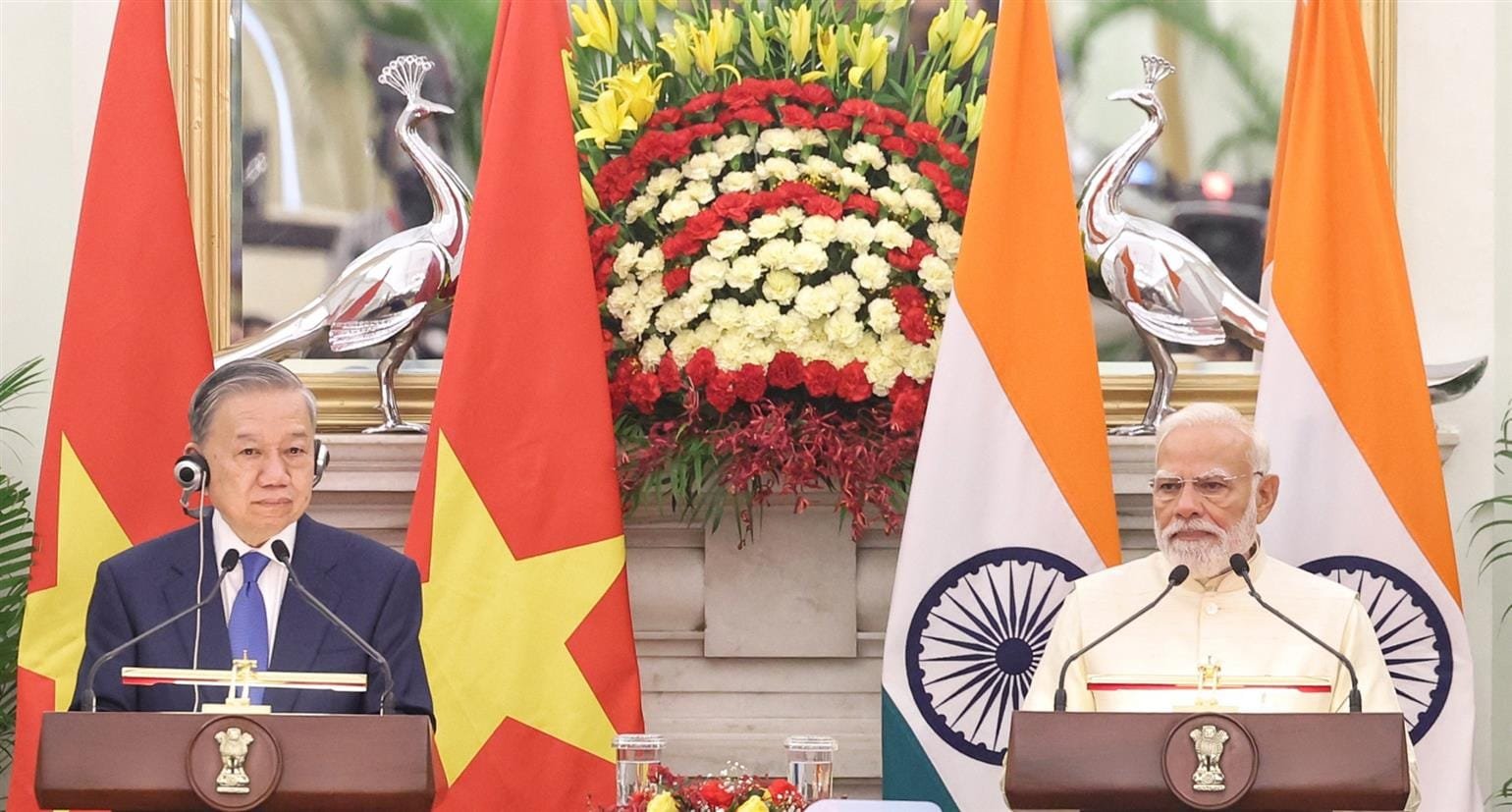
Rare Earth MoU signed by IREL and VINATOM
Prime Minister Narendra Modi and Vietnam’s President To Lam, who paid a State Visit to India from 5-7 May, have set a new target of US$25 billion bilateral trade by 2030 and accelerate the effective implementation of the Plan of Action between their two countries for the period of 2024 – 2028.
The two leaders agreed to reinforce cooperation in the two countries rapidly growing economies at the level of governments and businesses for increasing two-way trade, investment and technological partnership.
“Noting the increase in bilateral trade in the last 10 years, the leaders emphasized the need to further enhance it in a balanced and mutually beneficial manner, and agreed on a new trade goal of US$25 billion by 2030,” the statement said on 6 May.
They decided that both sides will facilitate market access, including for agricultural products in respective countries. They welcomed the decision to grant market access for Indian Grapes and Vietnamese Durians. They also agreed to expedite market access for Indian Pomegranates and Vietnamese Pomelos, by quickly resolving technical issues through expedited bilateral consultations.
Both sides agreed to enhance the supply chains in sectors of mutual interest. Vietnam affirmed its commitments to diversify its supply sources and to import more products from India to serve its domestic production and export needs. Both sides agreed to explore ways for a more conducive regulatory environment to facilitate ease of doing business for companies of both countries, including in standards compliance certification. They underlined the importance of maintaining constructive dialogue for resolving mutual concerns under bilateral institutional mechanisms.
The leaders agreed that the ongoing review of the ASEAN India Trade in Goods Agreement (AITIGA) should be concluded at the earliest. They concurred that the resulting agreement should be mutually beneficial, trade facilitative and relevant to current global trading practices.
The leaders agreed to encourage greater two-way investments to further strengthen India-Vietnam economic ties, especially in the fields of high-technology, transport, manufacturing, logistics, renewable energy, smart agriculture, electric vehicles and information technology, healthcare, agriculture and agro-processing, aquaculture, tourism and hospitality, among others. They also agreed to strengthen the linkages between the two countries’ startup ecosystems and encourage substantive cooperation among innovation centres.
Commending the decades-old institutional linkages between India and Vietnam in the field of oil and gas exploration, and recognizing the mutually beneficial cooperation in this sector, the leaders agreed to further enhance the exploration and production activities, including development of new wells where Indian companies are interested in participating, in accordance with Vietnamese law and international law, particularly the 1982 UNCLOS.
Recognizing the growing importance of e-commerce and the digital economy, the leaders agreed to strengthen cooperation in these areas, through enhanced sharing of experiences in developing enabling regulations and policies to support their growth and support businesses, especially MSMEs to participate in e-commerce to integrate deeply and sustainably in the regional and global value chains.
The leaders reaffirmed that defence and security cooperation is a key pillar of the India-Vietnam Comprehensive Strategic Partnership. They commended the effective implementation of the Joint Vision Statement on India-Vietnam Defence Partnership towards 2030, which continues to guide the growing defence ties between the two countries.
The leaders agreed to further strengthen cooperation and enhance engagements in both traditional and emerging areas of defence cooperation, including defence policy dialogue, joint exercises, staff talks, joint research and co-production of new defence technologies, enhanced port calls by Naval vessels and Air force aircrafts, peacekeeping activities, information sharing, hydrography, defence exhibitions, capacity building, defence industrial cooperation, maritime security, maritime safety, and search and rescue operations based on mutual interest and priorities of the two countries, which will also contribute to greater stability in the wider Indo-Pacific region. They also decided to enhance defence systems procurement between the two countries.
The leaders welcomed the steady progress in the implementation of the Defence Lines of Credit extended by India for Vietnam, which have contributed to strengthening Viet Nam’s defence capabilities and advancing bilateral defence cooperation.
The leaders expressed satisfaction on the implementation of the bilateral defence agreements, including Mutual Logistics Support Agreement; Memorandum of Agreement on Submarine Search and Rescue Support and Cooperation; and Letter of Intent on Strengthening Defence Industrial Cooperation.
The leaders welcomed the inaugural joint hydrographic survey by the two navies in May 2025 off the coast of Vietnam and agreed to regularly conduct similar exercises in the future.
Vietnam appreciated the training offered by India for Vietnamese defence personnel under the Indian Technical and Economic Cooperation (ITEC) Programme, through Indian Army, Navy, and Air Force Training Teams at the Telecommunications University (TCU), Naval Academy, Airforce College, Nha Trang towards capacity building; India’s support for the establishment of the Army Software Park at TCU, Nha Trang. The leaders welcomed that two countries would co-chair the ASEAN Defence Ministers’ Meeting-Plus Experts’ Working Group (ADMM-Plus EWG) on Cyber Security for the 2027-2030 cycle.
Recognizing that India and Vietnam are maritime countries with a millennia-old history of exchanges, the leaders emphasized maritime domain as one of the key pillars of their cooperation and called for enhanced maritime cooperation between the two sides. They noted that the bilateral Maritime Security Dialogue has fostered mutual trust and better understanding of respective concerns and underscored the importance of convening it regularly.
The leaders reiterated the significance of digital technologies and welcomed the signing of the MoU between Reserve Bank of India and State Bank of Vietnam on financial innovation and digital payments. They agreed to promote linkages for retail payment platforms via QR Codes that would facilitate tourism and businesses of both sides.
The leaders agreed to facilitate greater collaboration and partnership in critical and emerging technology areas such as Digital Public Infrastructure, 6G, Artificial Intelligence, space and nuclear technology, marine sciences, biotechnology, pharmaceuticals, advanced materials and critical minerals. Cooperation will focus on practical initiatives such as joint research, R&D centers, and product development as mutually beneficial.
The leaders acknowledged their respective climate, sustainable development goals and energy transition priorities and agreed to enhance cooperation in clean and renewable energy, as well as climate and disaster resilient technologies. They recognized the relevance of Mission LiFE (Lifestyle for Environment) and institutions such as International Solar Alliance (ISA) in this regard. India welcomed Viet Nam’s interest to join the Global Biofuels Alliance (GBA). The leaders also acknowledged the importance of the Coalition for Disaster Resilient Infrastructure (CDRI) in promoting international cooperation in disaster risk reduction and resilience. They encouraged further cooperation in applying digital and advanced technologies in smart agriculture, sustainable water management, and air pollution control.
The leaders noted with satisfaction the ongoing collaboration in the field of peaceful uses of atomic energy and agreed to intensify follow-up on various avenues of further cooperation emerging from the 4th India-Vietnam Joint Committee Meeting on atomic energy. India appreciates Vietnam’s invitation to participate in its nuclear power sector. Viet Nam thanked India for the supply of Cobalt-60 and both sides agreed to explore modalities for its continued supply to Vietnam.
They noted the progress towards the establishment of the ASEAN-India tracking, data reception station and data processing facility in Vietnam. Vietnam agreed to expedite the remaining processes on its side with a view to facilitate the completion of project at the earliest.
The leaders welcomed the signing of MoU between IREL (India) Limited and the Institute for Technology of Radioactive and Rare Elements, VINATOM on mutual cooperation in the field of Rare Earths, and emphasized its early and full implementation.
The leaders commended the extensive and impactful development partnership between the two countries, underpinned by the Quick Impact Projects (QIPs) under Mekong-Ganga Cooperation framework, ITEC programmes, and educational scholarships. They noted with satisfaction implementation of 66 QIPs through India’s support across 32 out of Vietnam’s 34 provinces, which have received widespread appreciation from local governments and communities for their grassroots socio-economic impact. Fiinews.com