Both sides acknowledged potential of trade settlement in local currencies
The 10th Session of the India–Kenya Joint Trade Committee (JTC) has reviewed bilateral trade and economic cooperation between the two countries which was US$4.31 billion in 2025–26, an increase of 24.91 per cent from US$3.45 billion in 2024–25.
The session agreed to further strengthen bilateral trade, the Ministry of Commerce and Industry said on 29 April. The meeting was held on 27 – 28 April 2026, in Nairobi.
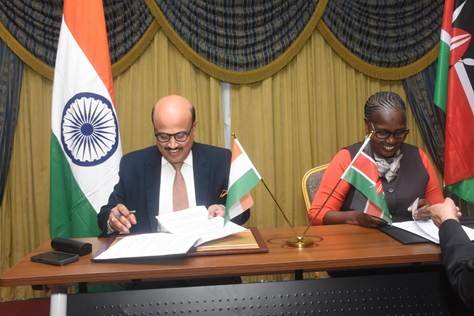
The meeting was co-chaired by Commerce Secretary Rajesh Agrawal, and Kenya’s Principal Secretary, State Department for Trade Regina Akotah Ombam (see picture).
Both sides noted the steady growth in bilateral trade, with India emerging as one of Kenya’s key trading partners. Discussions focused on enhancing trade diversification, addressing market access issues and leveraging complementarities in sectors such as engineering goods, pharmaceuticals, agriculture and electronics.
The Committee reviewed progress on ongoing trade facilitation initiatives, including the Memorandum of Understanding (MoU) between the Bureau of Indian Standards (BIS) and the Kenya Bureau of Standards (KEBS) to promote cooperation in standardisation and conformity assessment.
An MoU was also signed between the Central Board of Indirect Taxes and Customs (CBIC) and the Kenya Revenue Authority (KRA) for exchange of pre-arrival customs information, with emphasis on streamlining customs procedures and improving ease of doing business.
Another MoU was signed between the Confederation of Indian Industry (CII) and the India Kenya Chamber of Commerce and Industry to promote trade, investment and industry collaboration on the sidelines of the JTC meeting.
Both sides acknowledged the potential for promoting trade settlement in local currencies. It was noted that Kenyan banks have opened Special Rupee Vostro Accounts (SRVAs) with Indian banks, and greater utilisation of this framework could facilitate smoother bilateral transactions. The possibility of adopting a Local Currency Settlement (LCS) mechanism was also discussed.
Sectoral cooperation in emerging areas was deliberated. In engineering and manufacturing, opportunities to expand exports of automobiles, machinery and construction equipment were highlighted, along with participation in exhibitions such as Autoexpo Kenya and The Big 5 Construct Kenya. Collaboration in infrastructure development, including railways, was discussed, with India offering support in feasibility studies, project management and supply of rolling stock for Kenya’s Standard Gauge Railway. Opportunities for collaboration in shipbuilding with Indian shipyards were also explored.
In pharmaceuticals, India highlighted its role as a supplier of affordable generic medicines and medical devices and proposed enhanced business-to-business engagement. Both sides also discussed enhancing trade in agricultural products while addressing sanitary and phytosanitary barriers.
In renewable energy, India expressed readiness to support Kenya’s clean energy initiatives, including solar and wind projects. The Kenyan side informed that it has conveyed its decision to sign the International Solar Alliance Framework Agreement and looks forward to signing it at the earliest. Discussions on digital public infrastructure covered collaboration on UPI-like payment systems, Bharat Connect and digital platforms to enhance financial inclusion.
Capacity building was identified as an important area of cooperation. India offered training programmes under initiatives such as the Indian Technical and Economic Cooperation (ITEC) programme in sectors including mining, earth sciences, healthcare and education. Collaboration in higher education, digital learning platforms and skill development was also discussed, along with promotion of student mobility under the “Study in India” programme.
Both sides reaffirmed their commitment to a diversified, balanced and future-oriented economic partnership and agreed to strengthen institutional mechanisms to facilitate trade, resolve pending issues and promote business-to-business engagement.
On the sidelines of the JTC, an India–Kenya Joint Business Forum was held with participation of leading Indian and Kenyan businesses, including representatives from the Confederation of Indian Industry (CII) and the Kenya National Chamber of Commerce and Industry (KNCCI).
Additionally, on the sidelines of the meeting, the India–Kenya Chamber of Commerce organised an interaction with the local Indian business community under the chairmanship of Commerce Secretary Rajesh Agrawal. The interaction was attended by the local Indian business community and the accompanying CII business delegation and focused on opportunities and experiences related to doing business in Kenya. Fiinews.com