
Rail 4,000 km to attract investments of Rs.16lcr
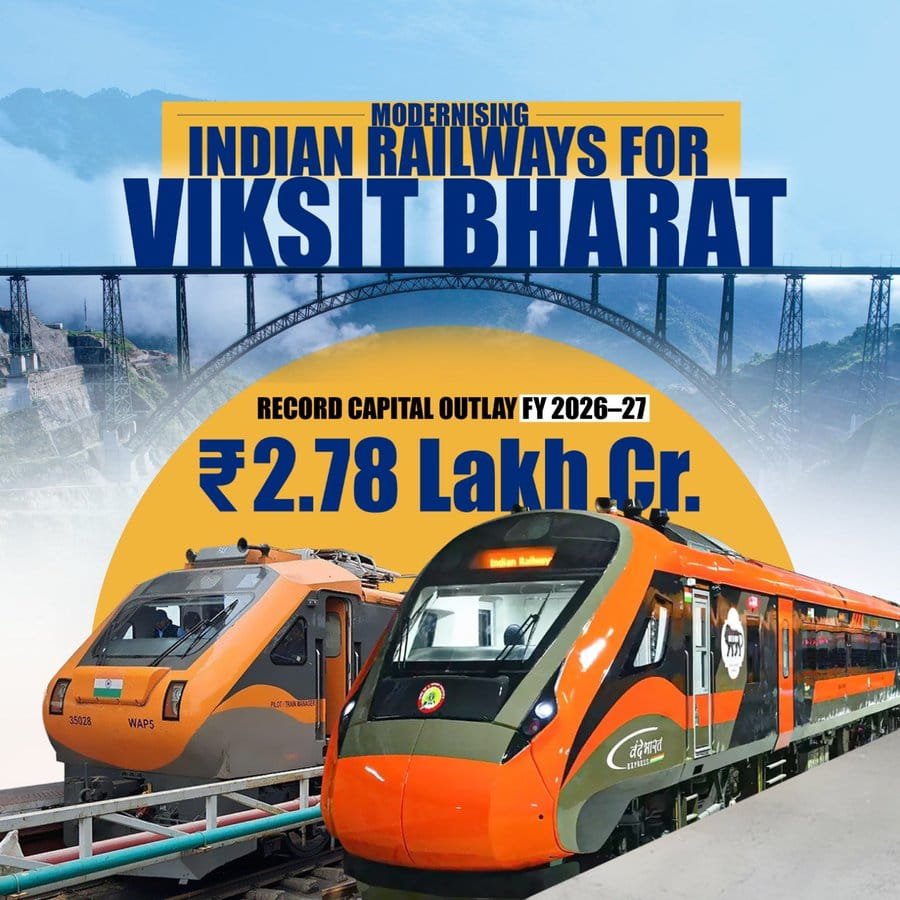
Indian Railways is set to expand at a rapid pace, backed by the substantial allocation of Rs.278,000 crore in the Union Budget this year, with spending on high-speed connectivity, freight and safety.
A record capital expenditure of Rs.293,030 crore has been planned for Indian Railways in the Union Budget 2026–27. This is the highest-ever capex as well as allocation for Indian Railways.
The allocation underscores the Government’s continued focus on strengthening railway infrastructure, expanding capacity and enhancing passenger safety, the Ministry of Railways said in welcoming the budget allocation.
“It reflects the emphasis on leveraging rail infrastructure as a key driver of economic growth and logistics efficiency. The sustained investment push aims to improve freight movement, reduce logistics costs, decongest high-density corridors and enhance passenger experience through modern trains and redeveloped stations,” the Ministry said on 1 Feb.
As part of its long-term vision, the Government has announced the development of seven high-speed rail corridors between cities as ‘growth connectors’ to promote environmentally sustainable passenger transport systems. These corridors include Mumbai–Pune, Pune–Hyderabad, Hyderabad–Bengaluru, Hyderabad–Chennai, Chennai–Bengaluru, Delhi–Varanasi and Varanasi–Siliguri. The proposed corridors are expected to significantly reduce inter-city travel time and facilitate seamless, multimodal movement of passengers.
With the announcement of the new corridors, the rail-based transportation ecosystem is expected to undergo a paradigm shift. In South India, the Chennai–Bengaluru–Hyderabad high-speed network will form a South High-Speed Triangle (or Diamond), connecting major economic and IT hubs.
Railway Minister Ashwini Vaishnaw, told a press conference on 1 Feb, “The seven high-speed corridors span nearly 4,000 kilometres and are expected to attract investments of approximately Rs.16 lakh crore, positioning railways as a central pillar of future mobility.”
In a major boost to freight movement and logistics efficiency, the Union Budget also proposes a new Dedicated Freight Corridor (DFC) connecting Dankuni in West Bengal with Surat in Gujarat, passing through Odisha, Chhattisgarh, Madhya Pradesh and Maharashtra. This 2,052-km corridor will integrate with the existing Western Dedicated Freight Corridor, enabling seamless movement of goods to ports along the west coast.
The Minister noted that the existing Eastern and Western DFCs are already operating at near-saturation levels, handling around 400 freight trains daily, necessitating additional corridors to meet future demand. “This East–West corridor will strengthen seamless trade flows across regions, decongest existing rail networks and enhance the efficiency of goods transportation, thereby supporting industrial growth and supply chains.”
He has highlighted that safety remains the top priority, with nearly Rs.1.20 lakh crore earmarked exclusively for safety-related works, and pointed out that sustained investments over the years have already yielded results, with railway accidents reduced by nearly 95 per cent.
He stated that the Government is now intensifying efforts to further strengthen safety outcomes. The focus areas include enhanced track, locomotive, wagon and coach maintenance, rapid deployment of the Kavach automatic train protection system, installation of CCTV cameras, upgradation of overhead electrical (OHE) systems, station redevelopment, and improved customer care and passenger facilities.
Vaishnaw said that propulsion systems are the most critical component of railway technology, and that propulsion systems designed and manufactured in India are now being exported to the top countries including USA, Switzerland, Germany, France and Spain.
The Minister also highlighted record achievements in infrastructure creation, including construction of 35,000 km of new tracks, 47,000 km of electrification, and electrification coverage exceeding 99.5 per cent of the broad-gauge network. He said manufacturing of Vande Bharat sleeper and chair car trains, Amrit Bharat and Namo Bharat trains, along with record induction of wagons, is progressing at an unprecedented pace.
Emphasising sustainability, Vaishnaw stated that rail transport is nearly 95 per cent less polluting than road transport, aligning closely with the Government’s environmental and climate commitments and reflecting the Prime Minister’s vision of railways as a green mode of mass transport.
The record allocation reinforces the role of Indian Railways as a backbone of national development, economic growth and inclusive connectivity. With the initiatives outlined in Union Budget 2026–27, Indian Railways is poised to play a decisive role in nation-building by delivering faster connectivity, efficient logistics and resilient infrastructure in line with the vision of Viksit Bharat, he underlined. Fiinews.com