
Phase 2 of PSA Mumbai container terminal virtually inaugurated
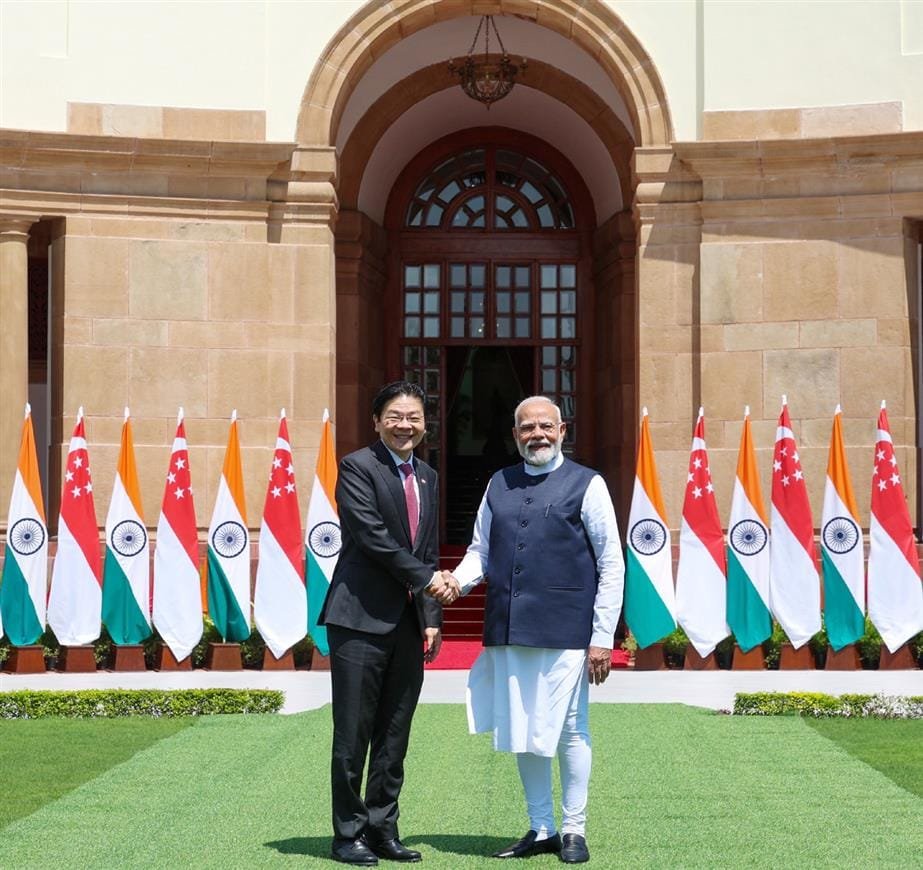
Singapore and India have worked out “an ambitious and detailed road map” to chart the next phase of their bilateral relationship following Prime Minister Lawrence Wong’s official visit to New Delhi from 2 to 4 Sept 2025.
Five agreements by the two countries to deepen cooperation across a range of sectors, such as skills development in advanced manufacturing, and green and digital shipping on Sept 4.
India and Singapore are celebrating 60 years of diplomatic ties this year.
Speaking to the press in New Delhi, PM Wong and his Indian counterpart Narendra Modi emphasised the deep and forward-looking nature of cooperation between Singapore and India, which is based on shared values.
Before making their remarks, the two leaders had witnessed the exchange of a joint statement on the road map for the comprehensive strategic partnership (CSP) between the two countries, as well as five memorandums of understanding.
The five agreements covered digital asset innovation, such as better support for cross-border data flows between each country’s central bank and capital market linkages; and establishing a green and digital shipping corridor with infrastructure and technologies to allow for the use of fuels with near-zero greenhouse gas emission.
The pact also included cooperation in civil aviation training, research and development; skills development in emerging sectors like semiconductors, electronics, and aviation maintenance, repair and overhaul; as well as in space industries like satellite communication.
To date, more than 20 Singapore-made satellites have been launched by India. “Both countries will broaden this partnership and push the boundaries of what can be achieved together,” said PM Wong.
Both leaders also witnessed the virtual inauguration of Phase 2 of PSA Mumbai, a container terminal at Jawaharlal Nehru Port in Navi Mumbai operated by PSA International.
The Phase 2 extension, when completed, would make PSA Mumbai India’s largest single container terminal, doubling its annual handling capacity to 4.8 million TEUs, said PSA in Singapore.
Designed to accommodate multiple mega container vessels alongside 2,000 metres of continuous quay length, PSA Mumbai is built to support India’s growing trade volumes for domestic and global markets. This development is the result of SG$1.7 billion (US$1.3 billion) committed by PSA International under a public-private partnership model, the largest foreign direct investment from Singapore in India to date.
In his remarks, PM Wong said that India has in the last decade made remarkable advances, and as the fourth-largest economy in the world today, its dynamism and influence are felt far beyond its borders.
The Singapore-India relationship has grown in tandem, and has also become more important in a world marked by great uncertainty and turbulence. This is as the partnership is rooted in mutual respect and a deep reservoir of trust, he added.
“We can draw strength from our shared history, and the friendship and trust between our people,” he said. “And together, we can strengthen resilience, seize new opportunities and contribute to stability and growth in our region and beyond.”
PM Modi said that collaboration between the two countries has not been limited to just traditional areas, but has changed with the times to cover new fields such as advanced manufacturing, green shipping, skills development, civil nuclear cooperation and urban water management.
To boost mutual trade, Singapore and India have also decided to review the bilateral Comprehensive Economic Cooperation Agreement (CECA) in a timely manner, while India is also reviewing its free trade agreement with the Association of South East Asian Nations, a 10-member nation grouping of over 630 million people Asean.
The Indian-Singapore annual trade has grown by about 2.5 times, from US$20 billion in 2005 to US$52.2 billion in 2023 under CECA which was implemented in 2005.
Singapore and India had agreed to elevate diplomatic ties to a Comprehensive Strategic Partnership (CSP) about a year ago, when PM Modi visited Singapore in September 2024. Under the CSP road map, Singapore and India committed to strengthening economic cooperation, including through a substantial review of the ASEAN-India Trade in Goods Agreement in 2025, the two governments said in a joint statement on Sept 4.
“Our confidence in India is not new. It is not a recent thing. It is longstanding, and it is backed by proven track record and actions,” said PM Wong in an interview with Hindustan Times.
Singapore is the largest investor in India for seven consecutive years now. “So, we will continue to invest in India. We will continue to have confidence in India’s prospects for the future. As to what industries and what areas, well, we have to leave it to the private sector,” he said.
The ISMR (India-Singapore Ministerial Roundtable) has made a lot of progress since it was first convened in 2022.
ISMR, in addition to CECA, is putting in fresh energy. Ministers and CEOs of leading businesses from both sides have held meeting under ISMR, a unique mechanism that will enable us to forge closer links with one another, strategically, said PM Wong.
Further, PM Wong believes the ASEAN-India relationship is a very important and critical one, especially as the centre of gravity of the global economy will, over time, shift toward Asia. “Within Asia, we already have China as one growth engine. India will be the second growth engine – there is no doubt. We think that ASEAN can be the third,” he highlighted in the interview with Hindustan Times.
He also shared Singapore’s concern relating to US-China and US-India. “So, in this very uncertain world, there is all the more reason for us to double down on this very critical India-Singapore relationship.” Fiinews.com