
PM Modi says India has significantly streamlined complex regulatory processes
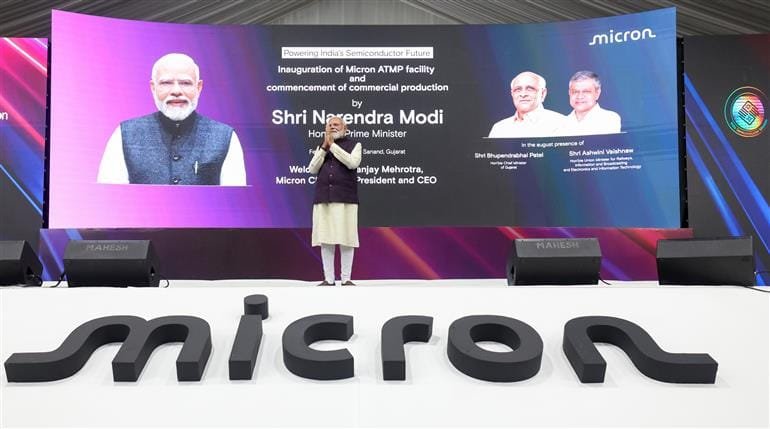
Prime Minister Narendra Modi has inaugurated the Micron ATMP (Assembly, Test, Marking, and Packaging) facility in Sanand, marking the commencement of commercial production which signifies a historic milestone in India’s journey toward global technology leadership.
He said on 28 Feb, “This inaugurated facility is a testament to India’s commitment to technology leadership and it is now rapidly strengthening its identity in the hardware sector.”
The commencement of commercial production at Micron’s ATMP Facility is set to bolster India’s role in the global technology value chain, underlined the Prime Minister, highlighting the “New India” mindset, where the transition from policy to production is happening at unprecedented speed.
The Prime Minister emphasised the project’s rapid progression, noting that the Memorandum of Understanding was signed in June 2023, followed by the groundbreaking in Sanand in September 2023. By February 2024, machine installation in the pilot facility had begun, leading to the commencement of commercial production in February 2026, he added.
PM Modi stated that India has significantly streamlined complex regulatory processes, successfully clearing Advanced Pricing Agreements (APAs) in just a few months, pointing out that such procedure typically takes between three and five years to complete, even in developed nations.
“When the intent is clear and the dedication is toward the nation’s rapid development, policies become transparent and decisions gain momentum,” he said.
The facility is a testament to the robust partnership between India and the USA, particularly in AI and chip technology, he highlighted, adding that both countries are working continuously to secure the global supply chain, citing the Pax Silica agreement signed during the AI Summit, held early Feb 2026 in New Delhi, as a key effort to make the supply chain for critical minerals more reliable.
Noting this century as the century of the AI Revolution, the Prime Minister called semiconductors a bridge to this change. Comparing historical shifts, PM Modi underlined that if oil was the regulator of the 20th century, the micro-chip is the regulator of the 21st century.
“A tiny chip is the medium connecting the Industrial Revolution to the AI Revolution. With this vision, India decided to move forward aggressively in the semiconductor sector,” he said.
The Prime Minister reiterated India’s commitment to the semiconductor sector, pointing out that while 10 projects have been approved under the Semicon India program, three more are set to begin production soon across various states, including Uttar Pradesh, Assam, Odisha, and Punjab.
“This ecosystem we are building is not limited to one region; it is Pan-India. New tech hubs for a ‘Viksit Bharat’ are being developed in every corner of the country,” said the Prime Minister.
A semiconductor ecosystem is far more than just a factory; it is a multi-layered system comprising machine manufacturers, design engineers, research institutions, logistics networks, and skilled technicians, he elaborated. “A chip is produced through the seamless coordination of all these elements.”
PM Modi continued, “India is focusing on the entire value chain. In this year’s budget, we announced the ‘India Semiconductor Mission 2.0’ for this very purpose.
Highlighting the scale of the growth, PM Modi added, “As production increases, the demand for materials, components, and services within India will also grow. This is the greatest opportunity.”
He went on, “A massive portion of India’s population is becoming first-time gadget users. Whether it is electronics, automobiles, or other technologies, demand is constantly rising. “Make in India” is now in full swing.”
Drawing parallels to Sanand’s transformation into an automobile hub, the Prime Minister expressed confidence that the Micron facility would anchor a new semiconductor ecosystem. The plant will produce D-RAM and NAND solutions to power global data centers, AI applications, and mobile devices.
He also lauded the facility for housing one of the world’s largest ATMP cleanrooms and its focus on environmental sustainability through minimized water consumption.
He highlighted that the policies created for the semiconductor sector are now yielding results on the ground.
“Simplifying processes like approvals, land allotment, and utilities has strengthened investor confidence. And with such initiatives and approach, Dholera and Sanand are developing as the semiconductor clusters of Western India,” he said.
The Prime Minister further stated that industries related to the inputs required for the semiconductor sector, such as chemicals and petrochemicals, along with skill centres and training initiatives, are being developed simultaneously.
PM Modi has sent out a powerful message to global investors, asserting, “India is ready. India is reliable. India delivers.”
He assured global partners and investors of unwavering support from both the Central and State governments, marking this decade as a historic turning point for India’s technological trajectory.
His address resonated globally with a clear, firm commitment: “India is Capable. India is Competitive. India is Committed.” Fiinews.com