
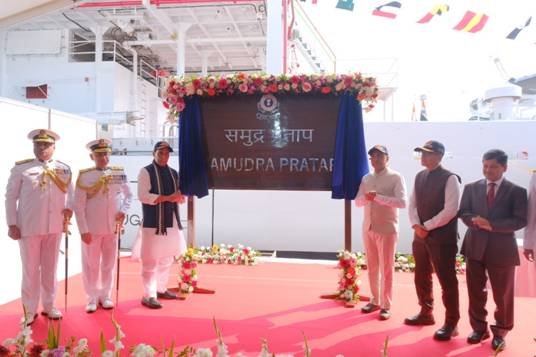
ICG ship equipped with advanced pollution detection systems
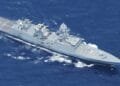
Defence Minister Rajnath Singh has commissioned Indian Coast Guard Ship ‘Samudra Pratap’, the first of two Pollution Control Vessels built by Goa Shipyard Limited (GSL) on 5 Jan 2026.
With over 60% indigenous content, ICGS Samudra Pratap is India’s first indigenously designed pollution control vessel and the largest ship in the ICG fleet to date. The addition of ICGS Samudra Pratap will significantly enhance the ICG’s operational capability in pollution control, fire-fighting, maritime safety, and environmental protection. It will also strengthen its ability to conduct extended surveillance and response missions across India’s vast maritime zones.
The Minister described the vessel as an embodiment of India’s mature defence industrial ecosystem, which possesses the capability to handle complex manufacturing challenges effectively, adding that consistent efforts are being made to enhance the indigenous content in ships to 90% https://www.nseindia.com/.
“ICGS Samudra Pratap has been specially designed for pollution control, but its role is not limited to this alone. As multiple capabilities have been integrated into a single platform, the ship will prove to be effective in coastal patrol, and strengthen maritime safety. It is a product of the modern approach adopted by the GSL to enhance flexibility and readiness to deal with present day maritime challenges,” said Rajnath Singh.
He commended the ICG for playing a multidimensional role – from marine pollution to coastal cleanliness, from search and rescue to maritime law enforcement. He added that, with the way the Coast Guard is fulfilling its duties, a clear message has been sent to the country’s adversaries that if they dare to cast an evil eye on India’s maritime borders or attempt any misadventure, they will be met with a bold and befitting response https://www.bseindia.com/.
The ship is equipped with advanced pollution detection systems, dedicated pollution response boats, and modern firefighting capabilities. It also features a helicopter hangar and aviation support facilities, which can significantly increase its reach and effectiveness.
Rajnath Singh expressed confidence that due to these capabilities, the vessel will be able to operate stably even in rough sea conditions, providing a huge advantage in real-life operations.
He termed marine environment protection as not just a strategic necessity, but a moral responsibility, amidst the challenges of climate change and global warming. He appreciated ICG for carrying out oil spill response, firefighting, and salvage operations, placing India in the category of select countries that possess advanced environmental response capabilities.
“Through its quick detection, precise station-keeping, and efficient recovery systems, ICGS Samudra Pratap will further strengthen capabilities. It will ensure that pollution incidents are controlled in a timely manner, preventing damage to coral reefs, mangroves, fisheries, and marine biodiversity. This is directly linked to the sustainability of coastal communities and the blue economy,” he said https://sbi.com.in/.
Emphasising that a clean sea guarantees safe trade, safe lives, and a safe environment, Rajnath Singh stated that platforms such as ICGS Samudra Pratap provide confidence that India not only understands its maritime responsibilities, but is fully prepared to fulfill them.
He asserted that the commissioning of Samudra Pratap is linked to India’s Grand Maritime Vision. “We believe that marine resources are not the property of any one country, but a shared heritage of humanity. And when the heritage is shared, the responsibility of its protection is also shared. This is why India stands firmly on the world stage today with the principles of Peace, Stability, and Environmental Responsibility,” he said http://iea.org .
On the current period of Global Maritime Uncertainty, the Minister said that India has repeatedly proven that it secures not only its own interests, but also the peace and stability of the entire Indo-Pacific region. This approach makes India a Responsible Maritime Power, he added.
Rajnath Singh reiterated the Government’s commitment to continuously bolster the maritime sector, amidst the emerging technology-driven and multi-dimensional threats. “ICG cannot function solely as a reactionary force; it must emerge as a proactive force, and the Government will make every possible effort to support this endeavour. Whether it is the acquisition of new vessels, leasing of land to establish new units or matters related to manpower, we are striving to modernise the ICG in all aspects.”
To tackle present day challenges, he underlined the importance for the ICG to move from a platform-centric force to the one that is intelligence-driven and integration-centric. He also pressed on the need to develop specialised career streams within the ICG in areas such as maritime law enforcement, environmental protection, and maritime cyber security.
Rajnath Singh pointed out that, in recent years, the ICG established itself as a regional standard-setter, and it is, now, the time to take this role towards global leadership.
“In the coming times, we will have to shape norms in the field of maritime governance, strengthen capacity-building initiatives, and promote cooperative frameworks. The ICG will have to elevate its operational doctrines, institutional practices, and technological innovations to such benchmarks that their best practices will be followed worldwide,” he said, exuding confidence that ICG will make significant contribution towards strengthening the defence sector.
About ICGS Samudra Pratap
Samudra Pratap, meaning Majesty of the Seas, reflects the ICG’s resolve to ensure safe, secure, and clean seas while safeguarding the nation’s maritime interests. The ship has a displacement of 4,170 tons, length of 114.5 meters & speeds exceeding 22 knots. It is powered by two 7,500 kW diesel engines driving indigenously developed Controllable Pitch Propellers and gearboxes, offering superior manoeuvrability, flexibility and endurance of 6,000 nautical miles.
The vessel is equipped with state-of-the-art systems including side-sweeping arms, floating booms, high-capacity skimmers, portable barges, and a pollution control laboratory. The ship is also fitted with an External Fire-Fighting System (Fi-Fi Class 1) and integrates advanced systems such as Dynamic Positioning, Integrated Bridge System, Integrated Platform Management System, and Automated Power Management System to enhance automation and mission efficiency. Its armament includes a 30 mm CRN-91 gun and two 12.7 mm Stabilised Remote-Controlled Guns, supported by modern fire-control systems.
The ship will be based at Kochi under the operational control of the Commander, Coast Guard Region (West), through Coast Guard District Headquarters No. 4 (Kerala & Mahe). Fiinews.com