
Russia expands list of Indian exporters
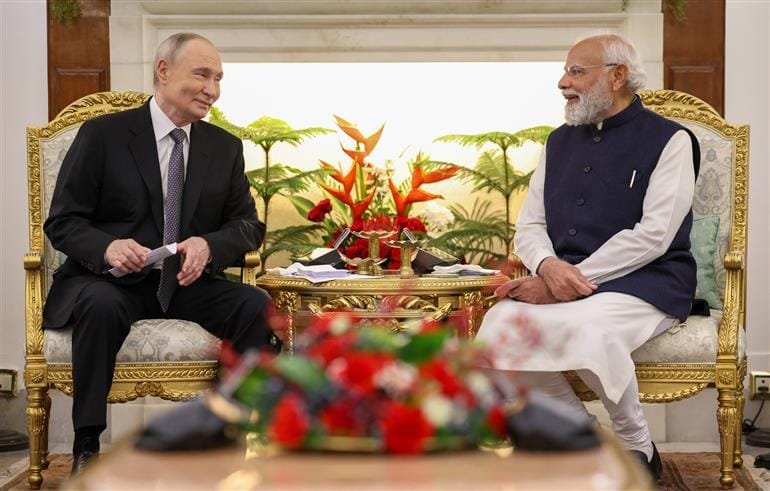
Discussions on a Free Trade Agreement (FTA) between India and the Eurasian Economic Union have begun, Prime Minister Narendra Modi told the India Russia Business Forum in New Delhi on 5 Dec.
He addressed the forum with Russian President Vladimir Putin at Bharat Mandapam who visited India 4-5 Dec.
“With the power of digital technology, we can connect customs, logistics and regulatory systems through virtual trade corridors,” said the Prime Minister as he elaborated on building bilateral trade of US$100 billion a year by 2030, a target set during Putin visit.
“This will speed up customs clearance, reduce paperwork, and make cargo movement more seamless,” said PM Modi.
He pointed out that Russia recently expanded the list of Indian companies eligible to export dairy and marine products from India. This has created new opportunities for Indian exporters. There is a huge global demand for India’s high-quality marine products, value-added seafood, and processed foods.
“We can form joint ventures and technology partnerships in cold chain logistics, deep sea fishing, and modernization of fishing harbors. This will also fulfill Russia’s domestic demand and Indian products will also get new markets.”
He also highlighted partnership of Indian-Russian in the form of joint ventures in the automobile sector. India is today a global leader in affordable, efficient EVs (Electric Vehicles), two-wheelers, and CNG mobility solutions. Russia is a major producer of advanced materials. “Together, we can partner in EV manufacturing, automotive components and shared mobility tags. This will not only help us meet our own needs but also contribute to the development of the Global South, especially Africa.”
He highlighted on why India is also called the Pharmacy of the World. “Together we can collaborate in joint vaccine development, cancer therapies, radio pharmaceuticals and API supply chain.
“This will enhance health care security and develop new industries. Fifth, textiles. India has vast potential, from natural fibres to technical textiles. We have a global presence in design, handicrafts, and carpets. Russia is a major producer of polymers and synthetic raw materials.
“Together, we can build a resilient textile value chain. Similarly, there are many possibilities for cooperation in areas such as fertilizers, ceramics, cement manufacturing, and electronics.”
Defence and space have been opened to the private sector, creating new opportunities in these sectors, PM Modi told the forum. “Now, we are opening the door to new possibilities in the civil nuclear sector as well. These are not just administrative reforms, but mindset reforms. There is only one resolution behind these reforms, a developed India.”
Elaborated PM Modi, “We are committed to moving forward on either the INSTC or the northern sea route, i.e., the Chennai-Vladivostok Corridor. Progress will be made in this direction soon. This will reduce transit time, lower costs, and open up new markets for business.
“With the power of digital technology, we can connect customs, logistics and regulatory systems through virtual trade corridors.”
Manpower mobility plays a vital role in enhancing cooperation across all sectors. Today, India is emerging as the skill capital of the world. “Our young talent has the potential to meet global requirements in every field, including technology, engineering, health care, construction, and logistics.
“Given Russia’s demographic and economic priorities, this partnership is extremely beneficial for both countries. By training Indian talent in the Russian language and soft skills, we can jointly create a Russia-ready workforce that will accelerate the shared prosperity of both countries,” he said. fiinews.com